

The supplier map can conceal the dependency
Two suppliers in different countries can still depend on the same transshipment port. Two telecommunications providers can buy capacity on the same cable route. A factory moved closer to its customers can remain exposed to imported fuel and a component that comes through a distant strait.
In each case, the procurement spreadsheet shows diversification. The operating system may still contain a shared point of failure.
Country risk remains essential. Governments control market access, sanctions, investment rules and the legal conditions under which companies operate. But a country-by-country assessment cannot show every dependency connecting a supplier to a customer. Boards also need to understand the corridors carrying the goods, energy and information on which their commitments depend.
The question is practical: if a critical connection becomes unavailable, what can the business actually switch to, how quickly, and at what cost? A credible answer requires more than identifying another line on a map.
Distance can rise faster than trade
The distinction between trade volume and transport work is revealing. UNCTAD's 2025 maritime review reports that seaborne trade grew by 2.2% in 2024, while ton-miles increased by 5.9%. Rerouting helped push the distance travelled up much faster than the volume moved. These are historical figures, not a forecast for current shipping conditions.
For a buyer, that difference can appear as longer replenishment cycles, more inventory in transit and less dependable arrival dates. A vessel spending longer on one round trip is unavailable for another. The effects can therefore reach businesses whose own cargo never passed through the disrupted route.
Research published in Nature Communications in 2025 reinforces the need to distinguish exposure from consequence. Its analysis of 24 maritime chokepoints considers disruption duration, rerouting possibilities and economic effects. A large share of trade passing through a strait does not by itself establish the loss a closure would cause. The availability and length of a detour matter.
That is a useful discipline for a leadership review. “We are exposed to this region” is too broad to determine an investment. “This product family would exhaust its usable stock before an alternative route could replenish it” identifies a problem that operations and finance can work on together.
Follow the flow beyond the first supplier
A corridor is the chain of connections that makes a business transaction possible. For physical goods, that can include an inland transport link, an export terminal, a shipping service, a transshipment hub, customs clearance and the receiving warehouse. The supplier's address describes only one point in that chain.
Start with a critical product or customer commitment and work backwards. Which inputs must arrive, in what condition and within what time window? Which transport services carry them? Where are goods consolidated? What changes if the carrier alters its network? A map should describe the routes actually used, with dates and owners for the information.
This also changes the conversation about a second source. An alternative supplier may reduce dependence on one company while leaving a shared terminal, upstream producer or transport service untouched. It can still be a useful investment, but its protection should be described accurately.
Our analysis of Asian integration considers the connections reshaping regional opportunity. For a supply-chain decision, the next step is to establish which of those connections the business needs and which it could replace. A new production location is valuable only in relation to the network that serves it.
Energy belongs on the same map
The 2026 disruption to energy flows through the Strait of Hormuz illustrates how corridor risk reaches beyond a company's own shipments. In its June Southeast Asia Energy Outlook release, the IEA reported that the Middle East accounted for 60% of the region's crude oil imports. It described consequences for petrochemical feedstocks, chemical products and liquefied petroleum gas. This is a regional exposure measure, not an estimate for every country or company.
By October, RBC Capital Markets' analysis continued to highlight the interaction between energy infrastructure risk and freight costs. The operating lesson is that commodity availability, the ability to transport it and the price of delivery need to be assessed together.
A manufacturer can purchase an input locally while remaining exposed to the international route supplying its producer. A service company can face higher costs through electricity, aviation or its customers' logistics. Moving the final assembly location does not automatically remove those dependencies.
Ask suppliers where their most consequential inputs originate and what would happen if replenishment slowed. Where detailed disclosure is commercially sensitive, seek evidence of tested continuity arrangements and recovery times. The aim is to understand the failure that could interrupt delivery, not to accumulate a complete database before taking any action.
The digital route has physical constraints too
Data connectivity requires the same scrutiny. The International Advisory Body on Submarine Cable Resilience's July 2026 report identifies geographical concentration and repair delays among the sector's vulnerabilities. Its recommendations address route diversity, permitting and preparedness as well as protection of the infrastructure itself.
For a corporate buyer, purchasing from two providers is therefore the start of a resilience discussion. Ask whether critical services have genuinely separate physical paths, landing points and supporting facilities. Establish which details the providers can verify, and distinguish that evidence from an assumption based on different brands.
Recovery also depends on what happens after a failure. A spare route with insufficient capacity may support essential transactions while leaving other services degraded. That can be acceptable if the business has agreed what takes priority and tested the resulting service. It is much less useful when the limitation is discovered during an incident.
The corporate map need not reveal sensitive infrastructure details to everyone. It should give accountable leaders enough evidence to judge whether an interruption can be contained, and who is responsible for validating the answer.
A four-part corridor review
The following is a proposed Scurati framework for a leadership discussion. It is a way to organise decisions, rather than a predictive risk score. Apply it to a small number of consequential flows before extending it across the business.
1. Exposure: identify what must keep moving
Choose a customer promise, product family or essential service. Trace the goods, energy and data required to deliver it. Include shared dependencies across suppliers and providers. Distinguish confirmed information from estimates, and give unresolved questions an owner. The output is a dependency map linked to a business outcome.
2. Substitution: establish a usable alternative
For each critical connection, describe the alternative and the conditions required to activate it. Consider available capacity, product qualification, customs documentation, insurance, handling requirements and contractual access. An alternative quoted under normal conditions may not be available when many customers need it simultaneously.
Test independence as well as existence. If both options rely on the same terminal or upstream input, record the remaining concentration. Where there is no practical substitute, focus on buffers, demand priorities and the time needed to restore service.
3. Time: compare switching with survival
Estimate how long the business can continue meeting its essential commitments after a disruption. Compare that with the time needed to detect the problem, approve a response and bring the alternative into operation. Include qualification and transit time, not just the time required to place another order.
For illustration, a business with twelve days of usable stock and an alternative requiring twenty days to deliver has an eight-day gap before allowing for decision delays. Those numbers are hypothetical. The point is to make the gap visible and decide whether to close it through inventory, earlier action, another source or a revised service commitment.
4. Authority: make the switch executable
Name the person authorised to act, the evidence that triggers the decision and the spending limit available. Agree who can change customer allocations and delivery promises. Procurement, operations, finance and sales should not discover their conflicting assumptions during the disruption.
Finish with a recorded decision: fund an alternative, run a test, increase a targeted buffer, redesign the dependency or explicitly accept the exposure. Assign a review date. A map without a decision owner will not move cargo or restore a service.
Price the protection against a specific failure
Resilience spending is easier to challenge when its purpose is vague. A second source, additional stock or reserved transport capacity each protects against a different problem. They also have different costs and can introduce new operational complexity.
Inventory may cover a short interruption but offer little protection if a product becomes unusable or a disruption persists. A second source can take time to qualify. Reserved capacity may still share an exposed route. The board should ask what each proposal protects, for how long, and what remains uncovered.
Compare the ongoing cost with a range of plausible interruption outcomes: contribution lost, recovery expenditure, penalties and consequences for important customer relationships. Use scenarios where probabilities are too uncertain to justify a precise expected-loss figure. Make the assumptions visible enough for the board to challenge them.
The same discipline applies to new corridor announcements. Political support or a signed memorandum does not establish an operating service. An investment case needs evidence about completed infrastructure, border procedures, service frequency, capacity and the commercial terms available to the company. Separate what operates today from what is planned.
Some exposure will remain worth accepting. The objective is to protect the commitments that matter most while preserving a commercially viable business. That requires explicit choices about which services must continue, which can be delayed and what the organisation is prepared to pay.
Bring the network into the investment decision
Our earlier discussion of geopolitical fragmentation asks what boards need to reconsider as the international environment changes. Corridor analysis makes that discussion concrete: it connects a political or physical disruption to an operating dependency and then to a choice about capital.
The next location, procurement or infrastructure proposal should show its critical connections alongside its country assumptions. It should also state which alternative has been tested, what it can support and who can activate it. That gives the board something more useful than a reassuring count of suppliers in different countries.
The strongest test is simple: if the primary connection failed tomorrow, could the organisation explain its next move without first commissioning another study?
Four perspectives for a corridor-risk discussion
These complementary editorial perspectives are selected for the decision at hand. The featured experts have not endorsed the framework.
The network behind the map

Parag Khanna ↗
The founder and CEO of AlphaGeo and author of Connectography brings a spatial view of infrastructure, trade and economic power. His contribution is to reveal the connections a country-by-country review can miss. Which network gives the business access to its markets, and where does that network concentrate exposure?The operating reality of a fallback

Ryan Petersen ↗
Flexport's founder and CEO brings the practical perspective of moving goods across borders. His lens tests whether an alternative can be booked, documented and delivered under pressure. What would prevent the organisation from executing the rerouting decision it has already approved?Energy and the transmission of risk

Helima Croft ↗
RBC Capital Markets' Head of Global Commodity Strategy and MENA Research connects geopolitics with physical energy markets. She broadens the supply-chain discussion to the fuel, feedstocks and freight conditions behind delivery. Which energy dependency remains hidden inside an apparently diversified supplier base?The +1 · Capital allocation under uncertainty

Dambisa Moyo ↗
The economist, Versaca Investments co-principal and author of How Boards Work moves the conversation from mapping exposure to allocating capital. Her board experience provides a useful challenge to operational proposals: which protection deserves funding, which risk can be accepted and who is accountable for that judgement?Books Shaping the Conversation
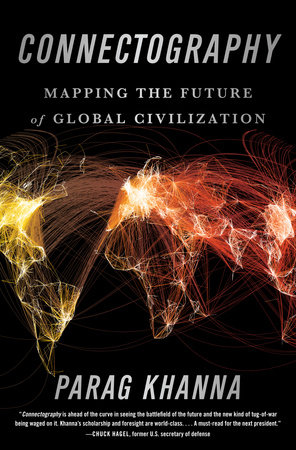
Connectography: Mapping the Future of Global Civilization
Explore Books to BookParag Khanna · Random House · 2016
A foundational lens on the transport, energy and communications networks shaping economic power. Read its connectivity thesis against today's fragmentation: a connection can create opportunity while concentrating exposure. Its older cases provide a conceptual starting point, not a current operating map.

The Power of Resilience: How the Best Companies Manage the Unexpected
Explore Books to BookYossi Sheffi · The MIT Press · 2015; paperback 2017
Examines how companies prepare for and respond to disruption, including deeper supplier dependencies and continuity planning. It adds the organisational detail behind a corridor map: detection, response and recovery. This is a foundational management work, rather than a guide to current geopolitical conditions.
From Insight to Stage
Build the next leadership session around one critical flow and a plausible disruption. Ask operations to describe the dependency, procurement to establish the alternative, finance to price the choice and the executive sponsor to assign authority. Use the external perspective to challenge those assumptions. The session should end with a funded test or an explicit decision to accept the exposure, with an owner and a review date.
Selected sources
- UNCTAD — Review of Maritime Transport 2025, 24 September 2025. Historical trade volume, ton-miles and rerouting evidence; latest edition located.
- Nature Communications — Systemic impacts of disruptions at maritime chokepoints, 2025. Modelled exposure, rerouting and disruption effects across 24 chokepoints.
- IEA — Southeast Asia Energy Outlook 2026 release, 16 June 2026. Regional energy import dependence and Hormuz disruption.
- RBC Capital Markets — Escalating Middle East tensions amplify energy supply risks, 15 October 2026. Energy infrastructure and freight-market context.
- ITU — International Advisory Body approves report on submarine cable resilience, 10 July 2026. Geographic concentration, repair and route diversity.
- ITU / ICPC — Working Group Recommendations, approved 2 February 2026. Deployment, repair, risk mitigation and geographic diversity.
