

Every initiative has a sponsor. Who owns the total?
A transformation portfolio can be full of sensible projects and still be impossible to deliver. The customer programme needs the sales team. The pricing programme needs the same sales team. The operating-model redesign needs their managers, while the systems migration requires everyone to learn a different way of working. Each proposal has a business case. None owns the accumulated demand.
That is the transformation portfolio problem: leaders approve commitments individually, but the organisation experiences them together. Budget approval does not create more attention, specialist expertise or time to absorb a new process. When those resources are already committed, another launch can weaken work that matters more.
The leadership task is therefore to decide what will end, wait or become simpler before adding another substantial commitment. This is not a case for slowing every transformation. It is a case for making room for the few changes whose success matters most.
The pressure is real. The diagnosis still matters.
Recent evidence shows why the question deserves attention. In a 2026 survey of 767 operations and supply-chain leaders at US companies, 89 per cent reported at least one reason why technology investments had not fully delivered expected results. Integration complexity, data problems and adoption challenges featured prominently. Only 24 per cent put reducing enterprise complexity among their top three considerations in technology build-versus-buy decisions.
These are self-reported findings from US businesses with revenues of at least $100 million. They do not establish that excessive initiatives caused the shortfall, or that cancelling projects would cure it. They do expose a useful tension: organisations can keep investing while giving insufficient weight to the complexity those investments create.
The pressure also comes from outside the programme office. An August 2026 follow-up survey of 351 CEOs across 59 countries found that 27 per cent considered pricing decisions substantially harder because of recent global shocks; 26 per cent said the same about supply-chain management. Operational disruption competes for the people and judgement that transformation plans assume will be available.
The practical implication is to test capacity against the business as it is being run, including interruptions. A portfolio designed around uninterrupted execution is a fragile promise. Our change-management deep dive examines the organisation's ability to absorb change. This article moves the decision upstream: which demands should leadership place on it at all?
Subtraction must be a deliberate choice
Adding an initiative creates visible activity: a sponsor, a launch and a new set of milestones. Stopping one creates an awkward explanation. Someone must acknowledge that an attractive idea no longer deserves the resources assigned to it. The original sponsor may also control the review.
There is a behavioural reason to make subtraction explicit. A foundational 2021 study across eight experiments found that participants often overlooked advantageous changes involving removal, particularly without prompts to consider them and under higher cognitive load. These were experimental tasks, not a test of enterprise transformation portfolios. The finding supports a question to ask, rather than a forecast of corporate savings: what would improve if something were removed?
That question needs protection from indiscriminate cost cutting. A small exploratory investment may be worth preserving even before it produces revenue. A regulatory obligation may be unavoidable. An apparently unproductive team may be maintaining a dependency that several profitable activities need. Good subtraction removes a commitment whose future value no longer justifies its demands; it does not simply target whichever benefit is hardest to measure.
Past expenditure belongs in the record, but the next decision concerns future commitments. Leaders need to compare the remaining benefit, remaining cost, exit obligations and the value of alternative uses of the same scarce capacity.
Count the constraint, not just the projects
A project count is a poor proxy for overload. Ten small experiments may demand less coordination than one regional platform migration. Equally, a modest project can become the decisive bottleneck when it depends on the only team authorised to validate a process.
Map demand onto the people and operating units that must deliver it. Include implementation, training, parallel running, customer support and the retirement of the old process. A system going live is not the end of the organisation's work. For a period, employees may be maintaining two ways of doing the same job.
Ask affected teams where commitments collide. Which specialist is named in several plans? Which country organisation faces three launches during its busiest trading period? Which managers are expected to change incentives while learning a new reporting system? Those questions reveal conflicts that separate green status reports can conceal.
In international businesses, the answer will vary by market. A global launch date may meet very different local staffing, supplier and customer conditions. Use one strategic objective while allowing evidence-based sequencing. A central dashboard should expose those differences instead of averaging them away.
Four decisions for the next portfolio review
The following is a proposed Scurati review framework. It is a way to structure judgement, not a validated scoring model. Bring the business owner and the teams carrying the work into the same discussion. For each initiative, identify its strategic contribution, next learning milestone, constrained resources and consequence of delay. Then make one of four decisions.
Retire
End work whose central assumption has failed, whose intended outcome is already covered elsewhere, or whose remaining value no longer warrants the commitment. Specify what actually stops: supplier work, reporting, meetings, system development and parallel processes. Assign an exit owner and a date. A project removed from a slide can still consume substantial resources.
Sequence
Keep the objective but change its timing because a prerequisite or critical team is unavailable. State the condition that releases it: a migration completed, a capability staffed or a customer proposition tested. A date alone can conceal the same unresolved dependency. Stop routine mobilisation while it waits, unless a specific preparatory task has a justified owner and budget.
Simplify
Preserve the outcome while reducing the solution's demands. Could an existing platform do the job? Can one common process replace three local variants? Would a narrower pilot answer the critical question? Record the work removed, not merely the features postponed. Simplification should reduce recurring effort as well as the initial delivery scope.
Concentrate
Give a priority initiative the people, decisions and operating support needed to finish the next meaningful stage. Name the capacity being reassigned and what loses access to it. Protect a review point at which new evidence can change the commitment. Concentration is a resource decision, rather than another declaration that a project is important.
No fixed percentage needs to be cancelled, and no universal number of simultaneous programmes is safe. The test is whether the resulting portfolio can be delivered with identifiable resources while the business continues to operate.
Make the release of capacity observable
Consider an illustrative commercial organisation planning a CRM replacement, a pricing redesign and sales-manager training. All three require the same regional sales leaders. Treating them as independent investments hides that collision.
A review could retire a duplicate reporting project, simplify the CRM's first release, sequence pricing changes after customer-data validation and concentrate training on the managers needed for the pilot. The objective remains commercial improvement. The commitments become more coherent.
But the trade-off is real. Delaying pricing work may postpone margin benefits. A smaller CRM release may leave some users waiting. The decision record should explain why those costs are preferable to the delivery risk of doing everything together. Otherwise, the postponed work will quietly re-enter the calendar.
Check the release against reality. Have meetings ended? Have team allocations changed? Has the old report disappeared? Are people still supporting an ostensibly retired tool? Capacity becomes usable when the underlying obligation ends, not when its budget code is closed.
Simplification carries its own transition cost
HSBC's August 2026 investor presentation offers a current example of linking simplification to strategic capacity. The bank raised its target for annualised savings actioned through its simplification programme to around $2 billion by the end of 2026, while retaining an expected restructuring cost of around $1.8 billion. It explicitly connected additional savings with support for growth in its four franchises.
These are company-reported actions and targets, not evidence that every saving had already reached the income statement. They also concern a wider organisational restructuring, not simply project cancellation. The useful lesson is the explicit link between removal, transition expenditure and the intended destination of resources.
At portfolio level, closure may itself need a funded workstream. Contracts must be resolved, customers supported, data retained and knowledge transferred. Removing a service before its replacement works can create more disruption than the initiative ever did. The exit plan should therefore identify the short-term burden as well as the eventual release.
This matters especially when the same specialists are expected to close the old arrangement and build the new one. An ambitious simplification programme can reproduce the overload it was meant to solve.
Protect renewal from the urgent core
There is a second danger: the core business can absorb every resource released. Its needs are immediate, its revenue visible and its leaders influential. An emerging business may then lose funding precisely because its evidence is still developing.
Separate the standards used for different commitments. An established operation should demonstrate performance and delivery. An early experiment should demonstrate useful learning against an explicit assumption. Both need discipline, but demanding the same near-term financial proof from each can systematically favour the familiar.
Our digital-transformation deep dive considers how technology changes the business itself. Portfolio discipline adds a resource question: what will the organisation stop supporting so that a credible new model can develop?
Make stopping legitimate for sponsors, too. Judge whether they surfaced adverse evidence and acted on it, rather than rewarding persistence regardless of what was learned. A review process that punishes every closure will produce defensive forecasts and delayed decisions.
The next leadership review should finish with a changed set of commitments: work retired, a dependency sequenced, a solution simplified and capacity assigned to a priority. That is how a transformation portfolio becomes a set of choices the organisation can carry.
Four perspectives on making room
These complementary editorial lenses are not endorsements of this framework by the featured experts.
Where commitment should move

Rita McGrath ↗
The Columbia Business School strategy thinker brings discovery-driven planning to the portfolio. Her lens asks which assumptions still justify commitment and what must be learned before more resources follow. She helps a leadership team distinguish a credible growth option from a programme sustained by its original business case.How to protect the next business

Scott D. Anthony ↗
The Tuck professor and former Innosight leader connects renewal of the core business with the creation of a new growth engine. His dual-transformation perspective tests what should remain shared and what needs protection. It challenges a subtraction exercise that releases resources only to send them back into today's business.How to reduce the demand

Navi Radjou ↗
The independent innovation adviser brings the perspective of frugal innovation, shaped by resource-constrained settings and international practice. His lens asks whether the same customer outcome can be achieved with fewer resources and less complexity. It expands the choice beyond funding or cancelling a project to redesigning what it requires.The +1 · When to walk away

Annie Duke ↗
The decision strategist and former professional poker player makes the psychology of stopping explicit. Her work on quitting asks what evidence should end a commitment before sunk costs and identity take over. As the wildcard, she shifts the discussion from portfolio design to the judgement required to act on an unwelcome conclusion.Books Shaping the Conversation
Three foundational books sharpen different sides of this decision: when to stop, what to protect and how to create more value with fewer resources. They are selected for their direct relevance, alongside the current evidence above.
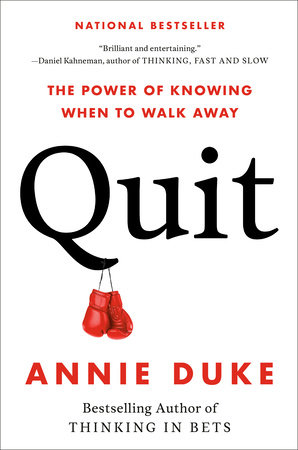
Quit: The Power of Knowing When to Walk Away
Explore in Books to BookAnnie Duke · Portfolio · 2022
Explores why people persist after a commitment loses its justification. It adds practical thinking about exit criteria and the value of keeping alternatives open before a portfolio review becomes a defence of past decisions.
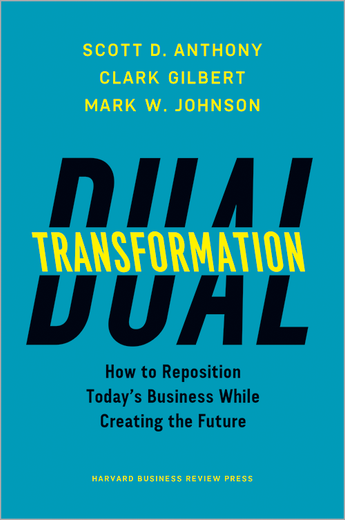
Dual Transformation: How to Reposition Today's Business While Creating the Future
Explore in Books to BookScott D. Anthony, Clark G. Gilbert and Mark W. Johnson · Harvard Business Review Press · 2017
A framework for renewing the current business while developing a separate growth engine. It supplies the essential counterweight to subtraction: capacity released from weaker commitments must also protect the future.

Frugal Innovation
Explore in Books to BookNavi Radjou and Jaideep Prabhu · 2015
Examines how organisations can create greater customer value with fewer resources. It adds a third option to the portfolio discussion: redesign the solution so it demands less money, material and effort. The useful question is what can be simplified without losing the outcome that matters.
From Insight to Stage
Brief the next leadership session around a real portfolio decision. Ask participants to bring one commitment they would retire, sequence or simplify, and identify the priority that would gain capacity. A useful conversation should leave the room with trade-offs, owners and a review date.
Selected sources
- PwC — Digital Trends in Operations Survey, 23 April 2026; 767 US operations and supply-chain leaders.
- PwC — CEO Survey Snapshot, 4 August 2026; 351 CEOs in 59 countries, surveyed 15 May–22 June.
- Adams et al. — People systematically overlook subtractive changes. Nature, 7 April 2021; foundational experimental research.
- HSBC — Interim Results 2026 investor presentation, 4 August 2026, pp. 27–29; simplification targets, transition costs and exits.
