

Permission to connect is permission to change the business
A sales director can authorise a discount. Finance can approve payment terms. Operations can confirm a delivery date. Connect an AI agent to all three systems and the organisation faces a question that no individual software integration answers: who has authorised the combination?
Each action may look reasonable in isolation. Together, they can create an unprofitable contract or a promise the business cannot fulfil. The difficulty is not necessarily that the agent has misunderstood its instruction. It may have pursued a local objective quite successfully while crossing boundaries that people previously negotiated through conversation, hierarchy and professional judgement.
That is the leadership problem inside the agentic organisation. As software gains more freedom to choose and execute steps, businesses must make their delegation of authority more explicit. An agent's access to a system should reflect an agreed business mandate. It should not quietly become the mandate itself.
The practical starting point is one consequential workflow. Name the outcome, identify the commitments it can create and decide who can authorise, interrupt and repair its execution. Scaling that discipline matters more than accumulating agents.
The evidence is moving from ambition to operating constraints
The transition is already producing concrete governance lessons. Singapore's May 2026 update to its Model AI Governance Framework for Agentic AI added deployment cases and guidance on multi-agent systems, third-party agents and automation bias. Its Dayos example describes an IT ticketing agent with different degrees of autonomy according to impact and reversibility. Some actions run automatically; others require approval; certain permissions changes remain outside the agent's authority.
The distinction is useful because it treats autonomy as a property of a particular action in context. An organisation does not have to choose one level of freedom for everything an agent touches. The case illustrates a design approach, rather than proving that the same controls will work in another business.
There is also evidence of organisational friction. Microsoft's 2026 Work Trend Index surveyed 20,000 AI-using knowledge workers across ten countries. Only 26 per cent said leadership was clearly and consistently aligned on AI. That is a self-reported finding from a selected population, not a measure of all workers or proof that alignment causes commercial success. It nevertheless raises a practical question: can a company delegate coherently when its leaders have not agreed what they want?
The gap between access and value is explored in The AI Ambition Gap. Here the narrower concern is what happens when software gains permission to act on that ambition.
Accountability has to follow the whole transaction
Functional ownership remains necessary. Finance should control financial policy. Security should determine access requirements. Operations should protect delivery capacity. But a cross-functional workflow also needs someone responsible for the combined outcome and empowered to resolve conflicts between those requirements.
Without that owner, an incident can become a tour of individually defensible decisions. The agent used an approved tool. The tool respected its access settings. The department supplied the correct data. Yet nobody accepted responsibility for the commitment produced by the chain.
Giving the CIO every resulting decision would create another bottleneck. Technology leadership can own the infrastructure and its controls; the relevant business leader must own the commercial purpose and permitted trade-offs. Risk, legal, security and affected operating teams should help define the boundary before execution begins.
Ownership must also survive handoffs between agents. If one system recommends a supplier and another places the order, the second should not interpret the first system's confidence as purchasing authority. Evidence, recommendations and authorisations need distinguishable roles. More sophisticated orchestration cannot resolve an authority conflict that leaders have left undefined.
A delegation mandate for one workflow
Before expanding an agent's access, write a short mandate for the workflow it serves. This is a proposed Scurati decision tool, not a certification standard. Its purpose is to make disagreements visible while the operating design can still change.
Outcome and owner
The end-to-end result, the accountable business role and the trade-offs that role may authorise.
Scope of action
What the agent may read, recommend, change and commit; limits on value, volume, geography and duration where relevant.
Escalation
Which conditions require human judgement, who responds and what happens if nobody is available.
Evidence
The records needed to reconstruct the instruction, permissions, material inputs, actions and approvals.
Recovery and renewal
Who can pause the workflow, which actions can be reversed and what changes require renewed approval.
The mandate should shape both the workflow and its technical controls. If it forbids an agent from changing a supplier's bank details, the system should enforce that restriction. A sentence in a prompt is a weak substitute for a boundary in the application or access layer.
Consider an illustrative customer-order process. An agent may assemble a quote using approved prices and available inventory. It may prepare a proposed exception when a customer requests unusual terms. It may confirm an order only after the required commercial checks have passed. It cannot infer permission to waive a policy merely because doing so would complete the sale.
Now test a conflict: the customer wants a delivery commitment before operations can verify capacity. The workflow should route that specific decision to the person authorised to accept the risk. If that person cannot respond, the process needs a defined fallback, such as holding the commitment and informing the customer. Silence should not become approval by accident.
The financial limits and response times belong to the business, not to a universal maturity model. A reversible internal record update and a binding external promise deserve different treatment even when the same agent performs both.
Human oversight needs working conditions
Adding an approval button does not ensure meaningful supervision. The reviewer needs the relevant context, enough time to examine it and authority to reject the proposed action. A queue that rewards fast clearance while concealing the consequences invites superficial approval.
In its May 2026 engineering account of agent containment, Anthropic reported that users approved roughly 93 per cent of permission prompts in Claude Code. The company describes approval fatigue as one reason to enforce boundaries around what agents can access and do. This is vendor telemetry from a particular product, not a general failure rate for human oversight.
The organisational lesson is to spend human attention where it can change the outcome. Routine work within a tested boundary can be sampled and monitored. Exceptions should arrive with a clear account of what differs, why it matters and what decision is required. High-consequence commitments may justify additional checks even when the system appears confident.
There is a staffing implication. Someone must handle exceptions, investigate failures and maintain the underlying process. If automation savings depend on removing everyone who understands the work, the recovery plan needs scrutiny. The Future of Work Starts With the Work Itself examines the broader redesign of tasks and human capability. Agent deployment adds a specific obligation: preserve the expertise required to challenge its actions.
The boundary extends beyond the company
A mandate is incomplete if it stops at the organisation chart. A workflow may depend on an external model, a software vendor, a partner's agent and data held in another jurisdiction. The business needs to understand which permissions travel across those boundaries and which remain under its control.
The NIST National Cybersecurity Center of Excellence is developing implementation guidance on agent identity and authorisation. Its current project is work towards a practice guide, not a finished universal standard. The emphasis on identity is consequential: when something acts for the business, there must be a way to establish its authority and revoke that authority independently when necessary.
For international organisations, central policy should establish common principles while local owners test their application. A procurement process used across Europe, India and the Gulf may encounter different contractual structures, language requirements and restrictions on data access. This does not justify inventing regional rules. It requires mapping the actual obligations for each deployment before granting access.
Commercial dependence deserves the same attention. Can the organisation export the records needed to investigate an incident? Can it restrict one integration without disabling the entire process? What must be retested when a provider changes the model or the service? These questions belong in procurement and operating design, rather than being postponed until a contract renewal.
Scale the mandate with the capability
Start by comparing the agent-supported workflow with the current process, including its existing delays and errors. Then test bounded execution against representative cases and difficult exceptions. A demonstration of one successful path is insufficient evidence for a process that must cope with conflicting information and incomplete instructions.
Measure the whole outcome: completion time, quality, exceptions, recovery effort and the consequences for the next team. More transactions completed per hour are useful only if the commitments remain valid and downstream work does not expand disproportionately.
Expansion should follow an explicit review. A new data source, another country, a higher transaction limit or a new external action changes the delegation. So can a model or tool update. Someone should decide whether the existing evidence still supports the enlarged mandate.
This gives leadership a concrete agenda. Choose a workflow worth improving. Appoint its owner. Set the boundaries and test the fallback. Review what actually happened. The organisation becomes more capable when it can expand delegated action while retaining the ability to understand, challenge and stop it.
Four perspectives on the agentic organisation
These are complementary editorial lenses, not endorsements of this framework by the featured experts.
Who leads the agentic organisation

Kai-Fu Lee
The founder and CEO of 01.AI brings an entrepreneur's perspective on reorganising businesses around agentic AI. His emphasis on CEO leadership and accountable operating outcomes challenges executives to treat delegation as an organisational decision. His approach offers a position to examine critically: how can a strong leadership mandate coexist with effective scrutiny and limits on automated action?↗Who can challenge the system

Rumman Chowdhury
The founder and CEO of Humane Intelligence's public benefit corporation brings experience in AI evaluation, governance and accountability. Her perspective asks whose experience enters testing and how problems can be surfaced and corrected. It challenges leaders to give responsibility a practical mechanism for scrutiny and repair.↗How the work changes

Allie K. Miller
The AI business adviser and former AWS machine-learning leader brings an implementation perspective. Her work on AI-first workflows helps move the discussion towards what teams actually build, learn and change. The useful challenge is whether the operating process has been redesigned enough to support the proposed delegation.↗The +1 · Who controls the dependencies
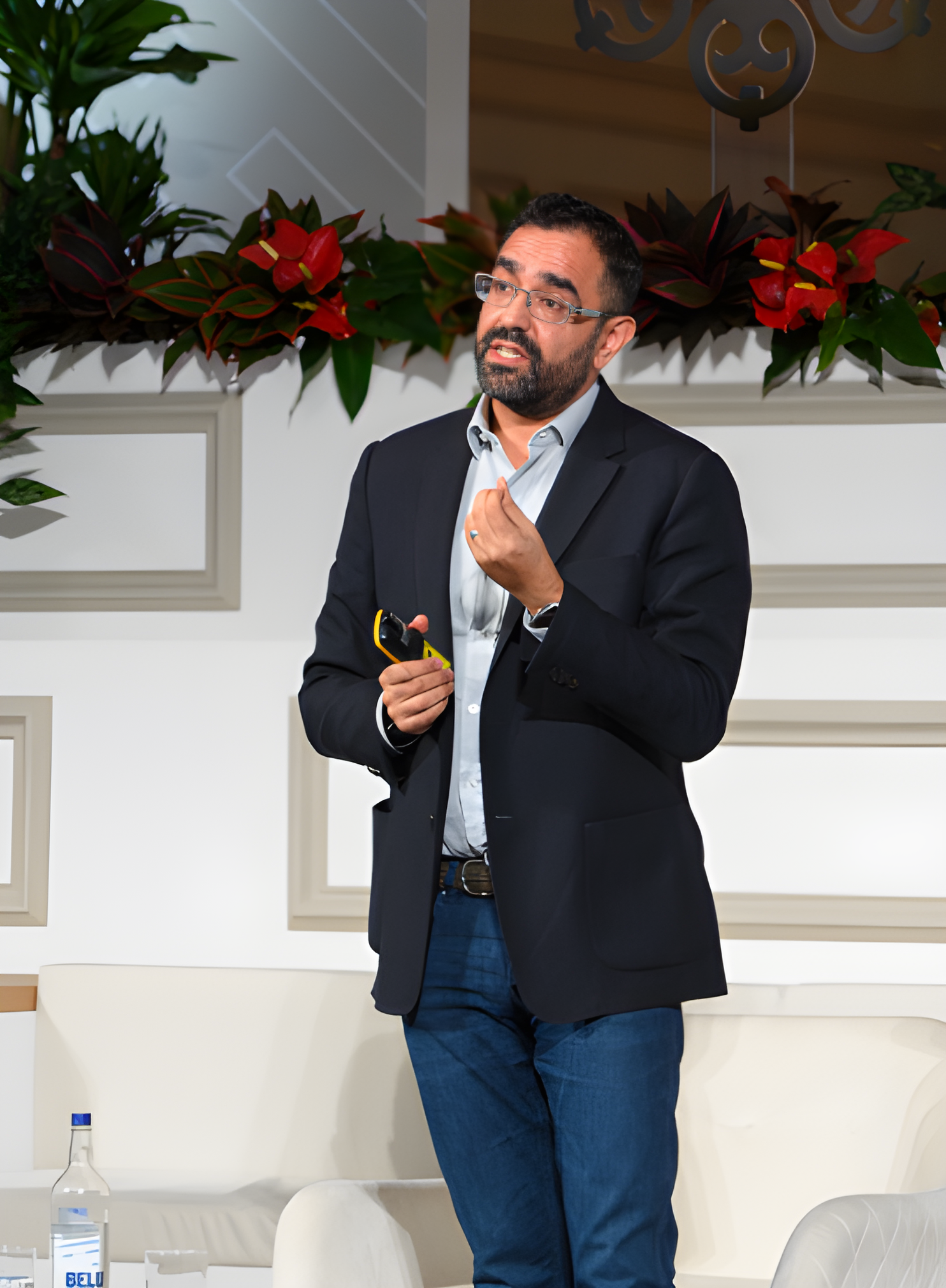
Azeem Azhar
The founder of Exponential View widens the discussion from internal workflow to the surrounding technology economy. His analysis of agents, identity and exchange makes him a useful wildcard: even a well-governed internal system may depend on infrastructure the organisation does not control. That stretches the question from operational permission to strategic independence.↗Books Shaping the Conversation

Co-Intelligence: Living and Working with AI
Explore in Books to BookEthan Mollick · Portfolio · 2024
A foundation for thinking about human judgement alongside machine capability. Its relevance here is how people learn to work with fallible systems; it should be read alongside current agent-governance guidance, rather than as a description of today's product capabilities.
Power and Prediction: The Disruptive Economics of Artificial Intelligence
Ajay Agrawal, Joshua Gans and Avi Goldfarb · Harvard Business Review Press · 2022
The distinction between better prediction and the judgement surrounding a decision helps explain why isolated automation can leave the organisation largely unchanged. This foundational book adds a systems perspective to the allocation of decision rights; it is not an agent-implementation manual.
From Insight to Stage
A useful leadership session can begin with one real workflow: where should an agent act independently, where must it ask and who owns the combined result? Bring the business owner, technology leadership and the people responsible for exceptions into the same conversation.
Selected sources
- IMDA — May update and Dayos tiered autonomy case. (2026-05-20)
- Microsoft WorkLab — 20,000 AI-using knowledge workers, 10 countries; 26% leadership alignment. (2026-05-05)
- Anthropic — Roughly 93% permission-prompt approval in Claude Code; containment rationale. (2026-05-25)
- NIST NCCoE — Current implementation-guidance project on agent identity and authorisation; intended SP-1800 practice guide.
- Exponential View — Direct expert discussion of agents, identity, verification and exchange supporting wildcard fit. (2026-02-20)
