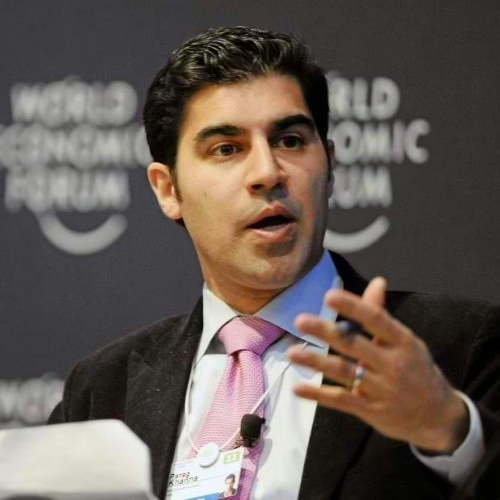
Dr. Parag Khanna Geopolitcal Keynote Speaker

Dr. Parag khanna

Founder and CEO of AlphaGeo, Founder of FutureMap, and Bestselling Author.

Dr. Parag Khanna is a leading global strategy advisor specializing in the intersection of geopolitics, globalization, and technology. He is a prominent voice on how connectivity, climate change, and demographic shifts are reshaping the world map and global economic power.

Keynote Topics:

  • The Future is Asian: Commerce, Conflict, and Culture in the 21st CenturyKhanna explores the "Asianization" of the world, explaining how the shift of global power toward the East impacts every industry. He analyzes the rise of a multipolar Asia and what it means for Western businesses and geopolitical stability.
  • Connectography: Mapping the Future of Global CivilizationThis session focuses on how infrastructure—including energy grids, transport corridors, and internet cables—is becoming more significant than political borders. Khanna argues that connectivity is the most important asset of the 21st century and explains how it dictates the success of nations.

  • MOVE: The Forces Uprooting UsKhanna examines the future of human geography in the face of climate change, demographic imbalances, and economic disruption. He discusses the necessity of "climate-resilient" migration and how countries must compete for talent and labor in a world on the move.

  • Global Strategy in an Age of DisruptionIn this talk, Khanna provides a framework for navigating supply chain volatility, digital transformation, and regional conflicts. He offers data-driven insights for organizations looking to build resilience in an increasingly fragmented yet interconnected world.


speaker Bio: 

Dr. Parag Khanna is a world-renowned strategist and geographer whose work focuses on the future of global civilization. He is the Founder and CEO of AlphaGeo, a leading predictive analytics platform for geospatial risk and climate-resilient investment, and the Founder of FutureMap, a strategic advisory firm. Recognized for his data-driven approach to geopolitics, Khanna has traveled to more than 150 countries, providing him with a unique, ground-level perspective on how the forces of globalization are manifesting across different continents.

His academic and professional career is marked by a deep commitment to understanding the mechanics of the "global system." Khanna holds a PhD from the London School of Economics and both Bachelor’s and Master’s degrees from the School of Foreign Service at Georgetown University. He has held prestigious research positions at some of the world’s most influential think tanks, including the Brookings Institution, the Council on Foreign Relations, and the New America Foundation. Through these roles, he has advised numerous governments and international organizations on matters of national security, economic development, and urban planning.

Khanna is a prolific and bestselling author whose books have been translated into dozens of languages. His "Global Trilogy"—comprising "The Second World," "How to Run the World," and "Connectography"—redefined the way scholars and business leaders view the world map. In these works, he introduced the concept of "functional geography," arguing that how we use the world (through supply chains and digital networks) is often more important than the political boundaries drawn on a map. His 2019 book, "The Future is Asian," accurately predicted the rapid integration of the Asian continent and its return to a dominant position in the global economy.

In his most recent major work, "MOVE: The Forces Uprooting Us," Khanna addresses the most pressing challenge of the coming decades: the mass migration of people. He combines climate science, demographics, and economics to explain why billions of people will likely relocate by 2050. He posits that the most successful nations of the future will be those that effectively attract and integrate mobile populations, turning migration into a competitive advantage.

Beyond his writing, Khanna is a frequent contributor to major global media outlets, including CNN, the BBC, and Al Jazeera, and his insights are regularly featured in publications like The New York Times, TIME, and Foreign Policy. He has been named a "Young Global Leader" by the World Economic Forum and serves on several international advisory boards. His work at AlphaGeo continues to push the boundaries of strategic foresight, using advanced geospatial data to help organizations prepare for the long-term impacts of climate change and shifting global trade routes.

 

Summary: Asianization & Global Connectivity Trends (2025-2026)

Based on Dr. Khanna’s ongoing research into "Asianization" and the "Great Re-mapping," several key trends are defining the current global landscape:

  • Multipolar Asia: The narrative has shifted from "China’s rise" to the rise of a multipolar Asian system. Countries like India, Vietnam, and Indonesia are emerging as critical anchors, creating a diverse economic engine that is no longer dependent solely on a single power or Western demand.

  • Intra-Asian Integration: Asia is "Asianizing" at an accelerated pace. Data shows that Asian nations now trade more with each other than with the rest of the world. This self-sufficiency is reinforced by massive infrastructure projects and the growth of local capital markets, reducing the region’s vulnerability to Western financial volatility.

  • The War for Talent & Wealth Capitals: Global mobility is being redefined by "Wealth Capitals" like Singapore, Dubai, and Riyadh. These cities are actively competing to attract the world's most talented individuals through flexible "nomad visas" and advanced digital infrastructure, becoming the new hubs of global innovation.

  • Climate-Driven Resettlement: As climate change renders certain areas uninhabitable, Khanna identifies a shift toward "Northern" and higher-altitude regions. This is creating new economic corridors and forcing governments to rethink sovereignty and citizenship in favor of more mobile, resilient populations.

  • Supply Chain Resilience (Tug-of-War): Globalization is not ending but is being "re-wired." The current trend is toward "just-in-case" supply chains, where connectivity is used as a strategic tool. Nations are engaged in a "tug-of-war" to control the high-value links of the global economy, from semiconductor manufacturing to green energy minerals.

speaker Video: