

THE ARGUMENT IN 60 SECONDS
- The shift: Visakhapatnam’s convention-centre ambitions sit alongside major digital-infrastructure commitments, creating an opportunity to connect local economic change with international business debate.
- Why it matters: A venue can accommodate an audience without becoming a destination for one. Beyond reliable access and facilities, a city needs programmes that convene relevant decision-makers around questions grounded in its economy.
- The decision: Develop the programme’s identity, expert relationships and audience proposition alongside the venue. Do not leave the intellectual case for attending until the building is ready and the event date is close.
A building is a promise, not a programme
At the CII Partnership Summit in Visakhapatnam in November 2025, Piyush Goyal made a proposal about the future of the gathering itself. India’s commerce and industry minister called for a permanent convention facility modelled on Delhi’s Bharat Mandapam and suggested the name “Andhra Mandapam”. The proposal is recorded in the government’s account of his address.
Read as a construction story, it is a proposal for a better place to meet. Read as a programming question, it asks something more consequential: what would persuade people with competing demands on their time to keep returning?
A convention centre makes a promise about human behaviour. Investors, policymakers, buyers and senior operators will choose to gather here rather than somewhere else. The building makes that choice possible. It cannot, on its own, make it worthwhile.
For India’s aspiring international convention destinations, that distinction should shape the investment from the beginning. Once essential infrastructure is in place, the harder-to-copy advantage is what we might call agenda authority: the credibility to convene a consequential industry conversation, with people whose knowledge and decisions matter to it.
That authority belongs to the programme and the community around it. It does not come with the keys to the building.
Investment creates the subject, not the audience
Visakhapatnam offers substantial material for such a conversation. In October 2025, Google announced approximately $15 billion of investment over 2026–2030 to establish its first AI hub in India there. Its plans combine gigawatt-scale data-centre operations, energy infrastructure, an expanded fibre network and a new international subsea gateway.
These are announced commitments, not evidence that every component is already operational. But they create concrete questions for businesses, public authorities and investors: how will power supply develop alongside computing demand? Which suppliers and skills will be needed? Where will the economic benefits extend beyond the infrastructure itself?
There is already a convening platform. CII lists the next Partnership Summit for 12–13 November 2026 in Visakhapatnam. The city is not starting with a building and no audience; it has an established event on which to build.
The opportunity is therefore not to invent relevance. It is to turn economic relevance into a programme with a recognisable purpose. A capital commitment supplies a subject for discussion. It does not automatically supply a reason for every potential delegate to attend.
Infrastructure is necessary. It is not the whole proposition.
Edward Glaeser offers a useful warning against confusing the physical setting with the activity it is meant to support. In a discussion reported by Harvard Gazette, the urban economist criticised regeneration strategies that assume construction itself will produce economic vitality. People, skills and the relationships through which they learn remain fundamental.
That is not a diagnosis of Visakhapatnam. The discussion concerned urban regeneration, not this proposed convention centre. Its relevance is a question for planners: what complementary activity must develop for the physical investment to fulfil its purpose?
For an international conference destination, flights, accommodation, accessibility, safety and dependable operations are essential. Strong programming cannot compensate indefinitely for a journey that is impractical or an event that is poorly delivered. Nor should domestic trade fairs or association meetings be dismissed as lesser uses of a venue; they may be central to its economic role.
But attracting a recurring international audience is a distinct ambition. It requires more than announcing capacity. Delegates need access to knowledge, people or opportunities that justify making this particular trip.
The useful test is not whether the programme sounds impressive. It is whether it would lose something important if it were moved to another city tomorrow.
A local question with a global frame
Parag Khanna’s Connectography provides one way to build that distinction. His account of global power emphasises the networks connecting cities through supply chains, transport, energy and communications, rather than treating national borders as the only meaningful map.
Applied to Visakhapatnam, that perspective suggests a programme about the intersection of maritime trade, computing and energy. The point is not simply to put “AI” on the agenda. It is to ask what this combination means for the companies and communities operating there.
One possible question is: how can a coastal industrial economy capture value from becoming a digital-infrastructure hub? That could bring an energy operator, a local employer, an infrastructure investor and a global strategist into a conversation with a common problem to solve.
International relevance should not mean importing an agenda. Local operators supply the constraints, experience and questions that make the discussion specific. External voices contribute comparisons and challenge assumptions. Each becomes more useful through contact with the other.
Connectivity needs a geopolitical counterweight
Connectivity alone is not a sufficient frame. Abishur Prakash offers a counterweight in The Great Fracturing, published in 2026. His argument centres on geopolitical forces pulling apart established arrangements and reshaping the networks through which business operates.
Placed beside Khanna’s connectivity lens, this raises a productive tension: new connections can create opportunity while also creating dependencies. Which political relationships, technologies and routes will a regional growth strategy rely on? How would changing access to them affect its economics?
The programme should investigate these relationships without assuming that every new project is a response to geopolitical fragmentation. The relative importance of market demand, commercial economics and political considerations is itself worth examining.
The resulting conversation is more demanding than a celebration of announced investment. It asks under which conditions that investment remains attractive, useful and resilient.
The programme must be allowed to question the promise
A third perspective tests what regional success would mean. In Breaking the Mould, Raghuram Rajan and Rohit Lamba argue for a development path built around human capital, high-skilled services and innovative manufacturing.
Their argument is not an assessment of Google’s Visakhapatnam project. Applied as a programming lens, however, it suggests questions worth placing beside an infrastructure announcement. What capabilities will local firms acquire? Which skills will workers need? What would demonstrate that the investment is broadening opportunity rather than simply expanding capacity?
These questions need not turn a summit into a confrontation between investment promoters and critics. They can make the discussion more useful to both. A skills provider, a regional entrepreneur and an infrastructure operator may disagree about what is missing while identifying practical ways to address it.
Agenda authority is weakened when every session must validate a conclusion agreed in advance. It becomes more credible when serious participants can examine the conditions under which the promise will be fulfilled.
Build the programme before the opening ceremony
This changes the work of state investment agencies, industry associations, venue owners and conference producers. The programme should be developed alongside the physical proposition, not added as an opening-season marketing exercise.
Four decisions deserve early attention:
- Choose a question the location makes sharper. Identify what the audience needs to understand, question or do differently, and why local knowledge is necessary to answer it.
- Build relationships across perspectives. Combine regional operators with relevant international researchers, practitioners and strategic voices. Geography alone is not a credential, and an overseas name is not a substitute for fit.
- Protect space for substantive challenge. Agree with hosts, sponsors and moderators which assumptions the programme will test. Independence should be designed into the brief, not discovered unexpectedly on stage.
- Plan beyond a single date. Start speaker conversations early and create a route from the first gathering to subsequent discussions, visits or working groups. Availability varies, but a late start reduces the time available to shape a coherent programme.
Early planning does not require booking every speaker years ahead. It means establishing the intellectual direction, relationships and commissioning process before urgency dictates the choices.
The test of success should also extend beyond the opening audience. Organisers can track whether relevant delegates return, whether discussions produce useful follow-up, and whether participants associate the event with a question worth addressing there. These are proposed indicators of programme value, not a claim that a keynote alone causes investment or growth.
For India’s emerging convention destinations, the opportunity is to develop both together: infrastructure that makes participation possible and a programme that makes it worthwhile. The building provides the room. The conversation earns the journey.
EXPERT PERSPECTIVES
Four lenses for a conversation worth travelling for
A programme about India’s changing economic geography needs perspectives that test different parts of the proposition. These four provide a starting point; the final selection depends on the audience, the question and availability.
Connectivity & networks
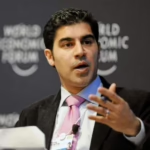
Parag Khanna
How cities gain relevance through supply chains, transport, energy and digital connections.↗Geopolitics & dependencies

Abishur Prakash
Which political forces reshape investment, technology access and the resilience of new economic hubs.↗India’s development choices

Raghuram Rajan
How human capital, institutions and local capabilities turn investment into broader opportunity.The +1 · Urban economics

Edward Glaeser
Why thriving cities depend on people and the exchange of ideas — and what buildings alone cannot deliver.↗For the wider strategic context, explore geopolitical fragmentation and business dependencies. For programme design, read why the right keynote starts with the question.
BOOKS SHAPING THE CONVERSATION
Triumph of the City
Edward Glaeser · 2011
A lens on the people, skills and connections behind urban prosperity, useful for testing what physical development can and cannot achieve alone.
Connectography
Parag Khanna · 2016
A framework for understanding cities through the supply, energy and communications networks that connect them to global economic activity.
Breaking the Mould
Raghuram Rajan & Rohit Lamba · 2023
A human-capital perspective that helps turn discussion of investment scale into questions about capabilities and opportunity.
SELECTED SOURCES