
Deep Dive: The Asian Pivot in an Era of Global Disruption
Clarity for leaders navigating geopolitical change—without noise.
Scurati curates the world's leading keynote speakers on the topics that matter most to your leadership agenda. This Deep Dive maps the experts behind the frameworks — and helps you bring them to your stage.
The Crisis Is the Clarity.
TL;DR: - Deep Dive: The Asian Pivot
The simultaneous eruption of geopolitical risk—Operation Midnight Hammer, the Strait of Hormuz closure, oil above $100, and the accelerating legislative assault on China's trade status—does not herald a new Cold War binary. It reveals something structurally more complex: a world fragmenting into overlapping, partially competing bounded orders that render the old US-centric playbook increasingly insufficient. Asia is not the passive recipient of this turbulence. It is emerging as the primary axis of global economic gravity, with ASEAN, India, China, and the Gulf city-states each exercising strategic autonomy that confounds Washington's alliance management. For corporate leaders, the implication is neither paralysis nor panic. It is the urgent need for a multi-axis strategic architecture that internalizes realist power calculus, geo-economic multiplicity, connectivity infrastructure, and the enduring centrality of China's domestic demand—simultaneously.
Executive Question:
As the Strait of Hormuz closes, the renminbi strengthens against the petrodollar, India reorders its agricultural supply chain, and Beijing accelerates its 15th Five-Year Plan—what does your company's operational posture look like in 18 months, and is your board equipped to govern that complexity?
I. The Realist Axis: John Mearsheimer and the Architecture of Bounded Orders
John Mearsheimer has argued for decades that great-power competition is structural—not contingent on ideology, regime type, or the personality of leaders. In the aftermath of Operation Midnight Hammer, launched in the early hours of March 1st, 2026, when US B-2 bombers and Israeli F-35s struck seventeen Iranian nuclear and energy infrastructure sites, Mearsheimer's framework achieves a grim explanatory clarity that even his critics find difficult to dismiss. The strikes, coordinated through what the Pentagon described as a 'finite deterrence operation,' produced an immediate response: the Islamic Revolutionary Guard Corps mined the Strait of Hormuz, halting 21 million barrels of daily oil transit and triggering the fastest single-week crude oil price spike since the 1973 embargo.
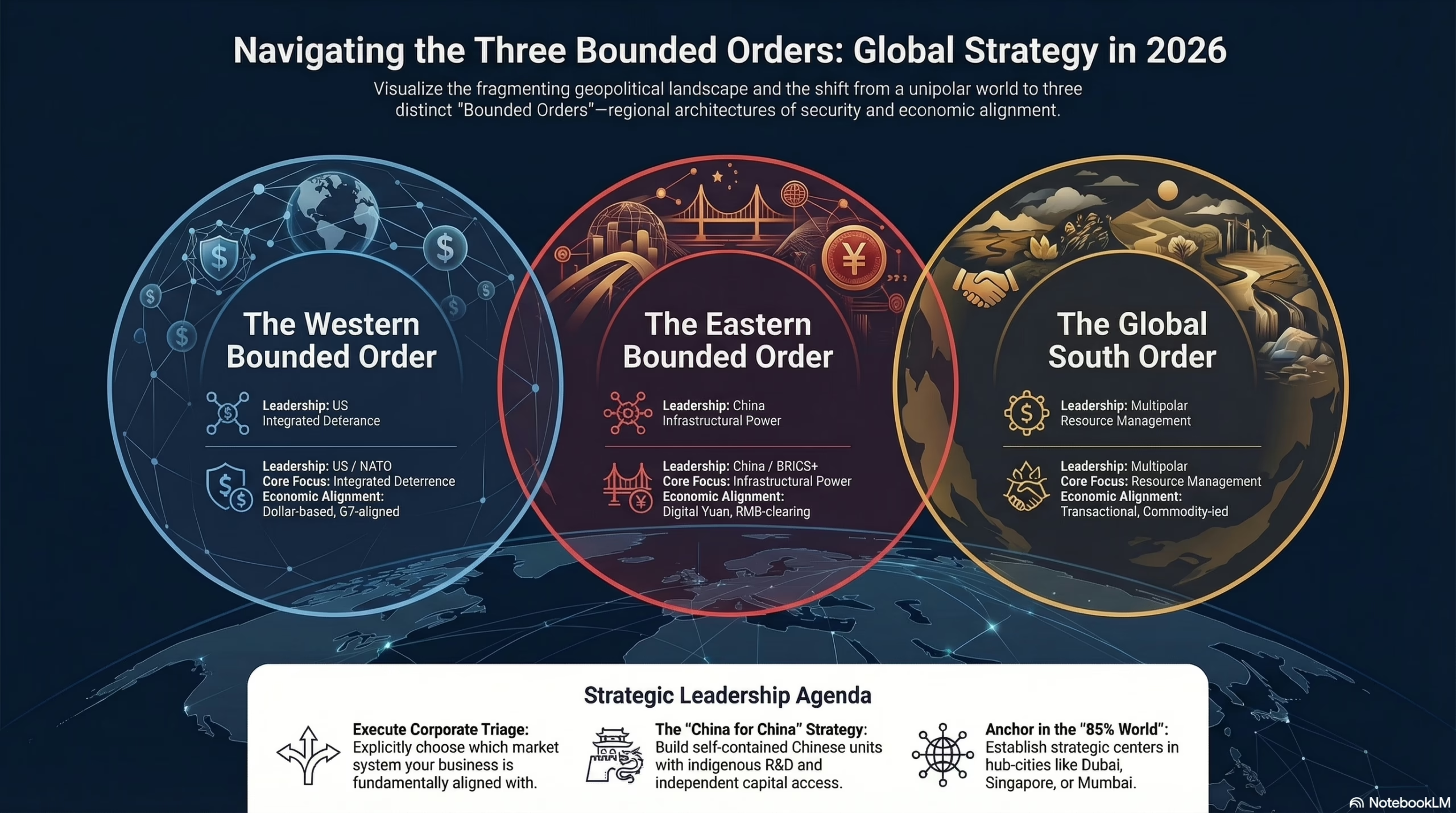
For Mearsheimer, the structural logic underlying this moment is straightforward: the United States, confronting the twilight of its unipolar dominance, has chosen kinetic escalation in the Middle East precisely because its capacity to shape outcomes in the Indo-Pacific has eroded. His concept of 'Bounded Orders' is essential here. Unlike the liberal international order, which posited universal norms and institutions capable of disciplining state behavior globally, Bounded Orders are regional architectures of security and economic alignment in which a dominant power maintains primacy within a geographically circumscribed sphere, while accepting that other spheres operate under different rules. The table below maps the three primary orders now in operation.
Order Type | Leadership | Core Focus | Economic Alignment |
|---|---|---|---|
Western Bounded Order | United States / NATO | Integrated Deterrence | Dollar-based, G7-aligned |
Eastern Bounded Order | China / BRICS+ | Infrastructural Power | Digital Yuan, RMB-clearing |
Global South Order | Multipolar | Resource Management | Transactional, Commodity-led |
Figure 1 — The Three Bounded Orders: Leadership, Focus, and Economic Alignment (March 2026)
The Trump administration's attempt to 'peel' Russia away from its strategic alignment with China—a project Mearsheimer views as conceptually confused and almost certainly doomed—illuminates the tensions within American grand strategy. Mearsheimer's structural realism predicts that Russia, regardless of its immediate tactical posture in Ukraine, has no durable interest in subordinating itself to Washington's Indo-Pacific containment agenda. The Sino-Russian relationship, though asymmetric and not without friction, is held together by the fundamental convergence of both powers' interest in dissolving the US-led unipolar order.
'The United States is not losing because it lacks will or resources. It is losing because the structural conditions that made unipolarity possible—technological supremacy, manufacturing depth, allied cohesion—have eroded faster than American strategic doctrine has adapted.' — Mearsheimer framework, applied to March 2026
For corporate strategists, the Bounded Orders framework has direct operational implications. Companies that have built their resilience strategies around WTO arbitration, ICSID investor protections, and bilateral investment treaties with universal enforcement assumptions must now model for a world in which those mechanisms function differentially depending on which bounded order a given transaction occurs within. The corporations that will navigate the next decade successfully are those whose boards have internalized that geopolitical risk is a structural feature of the operating environment—not an external shock to be managed reactively.
II. The Economic Security Axis: Dr. Jonathan Ward and the Logic of Corporate Triage
Dr. Jonathan Ward's framework, developed through his work at Atlas Organization and crystallized in his concept of the 'Decisive Decade,' argues that the competition between the United States and China is not primarily military—it is economic, technological, and institutional. The current crisis—with oil above $100, fertilizer supply chains under acute stress, and Congress moving decisively on legislation to revoke China's Permanent Normal Trade Relations status—validates Ward's thesis with an urgency that even skeptics within the business community can no longer ignore.
The PNTR revocation movement has gained critical legislative momentum in early 2026. The House China Select Committee's March 2026 report estimates that restoring Most Favored Nation conditionality to US-China trade would expose approximately $680 billion in annual bilateral trade to tariff renegotiation, with a minimum 35% tariff on all Chinese goods and upward of 100% on strategic minerals. Ward's contribution is to reframe this not as a political event but as a corporate triage moment: companies must now make explicit, irrevocable choices about which market system they are fundamentally aligned with.
Ward's 'Corporate Triage' framework operates on three levels. At the first level—supply chain topology—companies must complete the shift from China-centric manufacturing to 'allied-nation anchoring': the deliberate concentration of critical production in countries whose strategic alignment is durable enough to survive the next twenty years of great-power competition. At the second level—technology portfolio—companies must conduct a rigorous audit of their R&D partnerships and joint ventures to identify exposure to Chinese intellectual property dependencies. At the third level—market positioning—companies must make a deliberate choice: are they Chinese-market businesses with global operations, or global businesses with Chinese revenue? The answer determines the entire capital allocation logic of the enterprise.
Ward's most provocative assertion is that the Decisive Decade is not a metaphor—it is a literal claim that the structural conditions defining the US-China competitive landscape will harden into irreversibility within a ten-year window, after which the costs of strategic repositioning become prohibitive.
The Hormuz closure amplifies Ward's framework in a dimension he had not fully modeled: energy security as a corporate governance issue. China's control of roughly 80% of global tungsten and 70% of lithium refining is now being deployed as a counter-sanctions instrument, with Western prices for terbium and dysprosium running four to five times above Chinese domestic levels—creating a 'green premium' that inflates the cost of both AI chips and renewable energy hardware. Companies with significant Asian manufacturing exposure are now confronting the reality that their production costs are indexed not merely to labor and logistics, but to the geopolitical stability of chokepoints that, for the first time since the 1980s Tanker War, have been weaponized against global commerce.
III. The Connectivity Axis: Dr. Parag Khanna and the Asianization of Global Order
If Mearsheimer provides the skeletal architecture of power and Ward maps the competitive fault lines, Dr. Parag Khanna supplies the most important corrective to Western-centric analysis: the recognition that Asia is not merely reacting to US-China competition—it is actively constructing an alternative gravity field that increasingly operates on its own terms. Khanna's concept of 'Asianization'—the process by which Asian institutions, supply chains, financial flows, and cultural norms become the default operating environment of global commerce—has moved from prescient observation to lived reality with remarkable speed.
The hyper-connectivity thesis that underlies Khanna's 'Asia First' doctrine is empirically grounded in infrastructure data that Western strategists consistently underweight. The ASEAN-India corridor—now anchored by the Colombo Port City, the expanded Penang Free Trade Zone, the Chennai-Bangalore semiconductor cluster, and the Singapore-Kuala Lumpur high-speed rail project—has created a functional economic spine that increasingly routes around both Western financial infrastructure and Chinese BRI leverage.
ASEAN's intra-regional trade volume crossed $3.2 trillion in 2025, surpassing for the first time the combined value of ASEAN's trade with both the United States and the European Union. This is not a marginal statistic—it is a structural inflection point. The infrastructure table below maps the competitive connectivity landscape as of March 2026, illustrating how distinct corridors are now operating at divergent speeds and under divergent geopolitical mandates.Initiative | Lead Actor | Strategic Goal | Status (March 2026) |
|---|---|---|---|
Belt and Road (BRI) | China | Eurasian Integration | Focused on Digital Silk Road |
IMEC Corridor | US / India / EU | Middle East Trade Link | Stalled — Hormuz Closure |
INSTC | Russia / India | Caspian-Persian Route | +40% Volume (Q1 2026) |
ASEAN Power Grid | Southeast Asia | Energy Interdependence | 30% Integration Achieved |
Figure 2 — Asian Connectivity Infrastructure: Lead Actors, Strategic Goals, and March 2026 Status
India's role in Khanna's framework deserves particular attention in the context of the current energy shock. The Hormuz closure has delivered an acute fertilizer supply crisis to South Asia. The Kharif planting season, which runs from June through October, is now at risk of yield compression in the range of 8–12% if the closure persists beyond April. This is not merely an agricultural story; it is a food security stress test that will accelerate India's strategic imperative to diversify its energy and fertilizer sourcing away from Gulf dependency.
'Asia is not becoming the new center of the world. It is reasserting the centrality it held for most of recorded history. The question for Western corporations is not whether to engage with this reality, but whether they engage early enough to shape the terms.' — Khanna framework, synthesized
Khanna's 'Asia First' doctrine implies a fundamental reorientation of corporate operating models. The traditional hub-and-spoke model—in which a US or European headquarters allocates capital to Asian subsidiaries serving primarily as manufacturing platforms—is being supplanted by what Khanna describes as a 'polycentric lattice': a distributed governance model in which Asian operations possess genuine strategic autonomy, P&L authority, and R&D capacity. The corporations that have already moved furthest in this direction—Apple's deepening of its India manufacturing posture, ASML's Singapore R&D expansion, ABB's ASEAN-focused energy transition business—are not engaging in risk diversification. They are positioning for the primary market of the next thirty years.
IV. The Multiplicity Axis: Afshin Molavi and the 85% World
Afshin Molavi's conceptual contribution is perhaps the most uncomfortable for Western C-suite audiences to internalize, because it requires abandoning the implicit assumption that the 'international community' is synonymous with the G7 plus allies. Molavi's '85% World' framework—so named because it encompasses the roughly 85% of the global population that resides outside the G7 democracies—posits that these nations are not waiting to be incorporated into a Western-led order. They are actively constructing their own institutions, supply chains, and normative frameworks, and the March 2026 crisis is accelerating rather than interrupting that process.
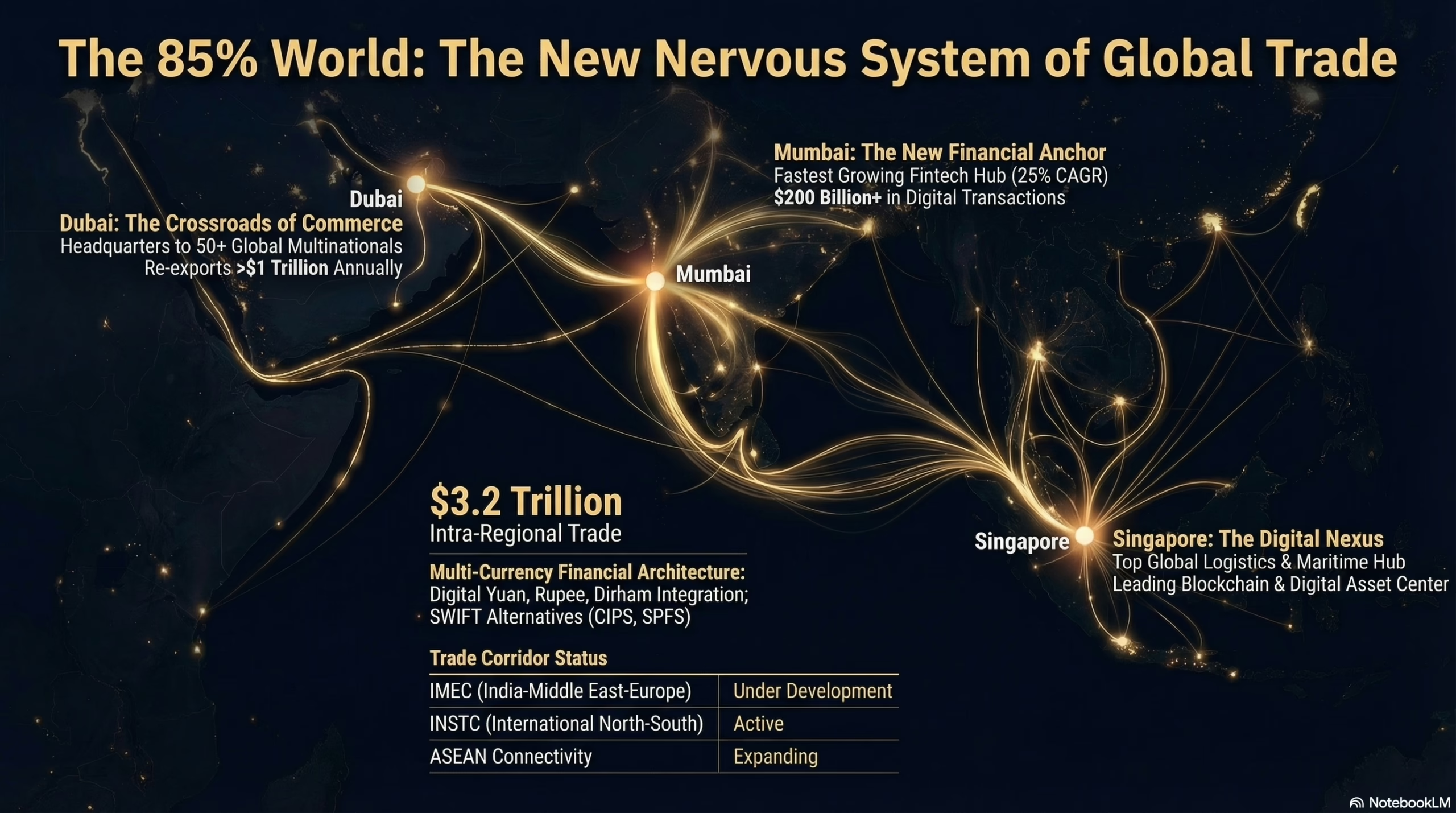
The Hormuz closure provides a near-perfect case study for Molavi's framework. The more consequential story is unfolding in the hub-cities that Molavi identifies as the nervous system of the 85% World: Dubai, Singapore, and Mumbai. Dubai's JAFZA free zone has already redirected $4.2 billion in commodity trading contracts away from Hormuz-dependent logistics routes toward the East African corridor and the Suez bypass. Singapore's commodity trading houses—Trafigura, Vitol, Gunvor—are restructuring their Asian crude procurement portfolios in real time. Mumbai, as the capital of a 'systemic emerging market,' is simultaneously processing rupee depreciation pressure from energy import costs and accelerating its positioning as a refining and chemicals hub for the Global South.
The supply chain reorientation that Molavi maps within the Global South is not driven by anti-Western sentiment. It is driven by the same rational calculation that drives all supply chain decisions: cost, reliability, and resilience. And on all three dimensions, South-South supply chains are increasingly competitive with North-South alternatives.
Molavi's hub-city thesis is not merely geographic—it is institutional. The DIFC has expanded its arbitration jurisdiction to cover $1.2 trillion in annual cross-border contracts, many of which specifically exclude Western legal frameworks as the governing law. Singapore's International Commercial Court has become the preferred dispute resolution venue for Indo-Pacific infrastructure contracts. These are the emerging institutional infrastructure of a parallel global order—one that operates by different rules, on different timelines, and with different assumptions about the relationship between commerce and sovereignty.
India's response to Gulf urea shortages illustrates the dynamic with precision. Rather than appealing to Western supply chains, New Delhi has accelerated bilateral agreements with Russia (potash), Morocco (phosphates), and Egypt (ammonia), all settled in rupees and UAE dirhams. Companies operating in Indian agricultural inputs, specialty chemicals, or related logistics must model for this reorientation—not as a temporary adaptation but as a durable structural shift.
V. The Integration Axis: Prof. Keyu Jin and the New China Playbook
Of the five analytical frameworks synthesized in this report, Prof. Keyu Jin's integration thesis is perhaps the most intellectually challenging for Western strategists to incorporate—not because it is counterintuitive, but because it requires holding two truths simultaneously: that China is a systemic geopolitical rival to the United States, and that stopping China's economic ascent is, as Jin argues plainly, 'not really possible' given its role as a structural demand anchor for the global economy. Jin's 'New China Playbook' is not a defense of the CCP's political choices; it is a rigorous assessment of the economic realities that constrain any decoupling strategy to the level of partial rather than comprehensive separation.
China's 15th Five-Year Plan (2026–2030), unveiled in preliminary form at the National People's Congress in March 2026, confirms Jin's central thesis. Beijing has internalized the Western decoupling agenda and responded not with panic but with a sophisticated pro-growth, innovation-led industrial strategy that systematically reduces China's vulnerability to Western technology restrictions while expanding its market penetration in the 85% World. The Plan's headline allocations—¥2.8 trillion in semiconductor self-sufficiency programs, ¥1.6 trillion in AI infrastructure directed toward industrial AI applications, and ¥3.4 trillion in clean energy manufacturing scale-up—represent a state-directed capital mobilization that no Western company or government can match on equivalent timelines.
Prof. Jin's most important insight for corporate leaders is that China's pro-growth pragmatism is not a phase—it is a structural commitment driven by the CCP's fundamental legitimacy bargain with its middle class. A China that fails to deliver material improvement faces political instability that no faction within the Party can afford. This makes growth a non-negotiable imperative, not a policy preference.
Jin's analysis of China as a 'systemic demand anchor' has direct implications for companies across every sector exposed to Asian consumer markets. Despite the structural headwinds of property sector deleveraging and demographic contraction, China's domestic consumption economy still represents the largest single pool of incremental consumer demand in the world. The foregone demand from a Chinese market that Jin estimates will add $2.3 trillion in retail consumption between 2026 and 2030 is not a rounding error—it is a strategic choice with compounding consequences that must be made explicitly at the board level.
VI. The Energy-Fertilizer Nexus: How Hormuz Reshapes Asian Food Security
The strategic and humanitarian implications of the Hormuz closure extend far beyond the $100 oil headline. The Strait is the transit corridor not merely for crude oil but for a complex web of petrochemical intermediates—naphtha, LPG, methanol—that are the feedstocks for the global fertilizer industry. Qatar, the world's largest single-source exporter of ammonia and urea, has effectively ceased exports. Iran's sulphur production, which supplies approximately 18% of global sulphur for phosphate fertilizer manufacturing, has been disrupted by both the strikes and the closure of Bandar Imam Khomeini's port operations. The scale of the disruption, product by product, is captured in the table below.
Fertilizer Product | Global Trade via Hormuz | Price Change (Mar 1–10) | Primary Vulnerable Markets |
|---|---|---|---|
Urea | 35% – 45% | +25% | India, Brazil, Italy |
Ammonia | 25% | +20% | EU, United Kingdom |
Sulphur | 40% | +30% | Global Ag-Chem Sector |
DAP | 15% | +5% | India, United States |
Figure 3 — Hormuz Fertilizer Shock: Global Trade Exposure, Price Changes, and Vulnerable Markets (March 1–10, 2026)
The cascade into Asian food security is direct and severe. India imports approximately 10 million metric tons of urea and 6.5 million metric tons of DAP annually, with roughly 75% of urea imports originating from GCC countries like Oman, Qatar, and Saudi Arabia—all of which are now logistically constrained. Indian urea producers have begun trimming output as LNG supplies from Qatar, a primary feedstock, are disrupted. The Kharif planting season planning window, which runs from June through October, is now at risk of creating what market analysts describe as a 'delayed but severe food inflation cycle' lasting through late 2026.
The strategic consequence that Mearsheimer, Khanna, and Molavi would each identify—from their respective frameworks—is consistent: the Hormuz shock accelerates every trend that was already underway. India's agricultural crisis will deepen its political imperative to build out domestic fertilizer production capacity, diversify its energy import portfolio toward Russian oil and Central Asian gas, and anchor strategic partnerships with countries capable of supplying potash and phosphates outside Western-controlled commodity networks. Companies positioned in Indian infrastructure, specialty chemicals, logistics, and precision agriculture technology face a structural demand acceleration, not a temporary cyclical shock.
VII. The Technology Paradox: Semiconductors, AI, and the Bifurcated Innovation Economy
The semiconductor supply chain is the domain in which the gap between public discourse and corporate strategy is most dangerous. The conventional narrative—that US export controls have successfully degraded China's AI capabilities—is partially true and strategically misleading. It is true that China cannot currently manufacture sub-7nm chips at commercial scale. It is misleading because it implies a static competitive dynamic that underestimates both the pace of Chinese domestic innovation and the strategic irrelevance of frontier AI for the majority of corporate use cases.
The $500 billion AI chip market projected for 2028 encompasses not merely the data center GPU segment that NVIDIA dominates, but the far larger and more commercially significant market for edge AI, industrial automation, automotive inference, and embedded AI applications—a segment in which 7nm to 28nm chips are entirely sufficient. The export control regime has successfully protected the frontier AI segment while inadvertently ceding the vastly larger and more commercially durable middle segment to Chinese competition. Advanced packaging constraints (CoWoS shortages), HBM memory tightening, and lead times beyond 50 weeks for 3nm-based accelerators are compounding the bottleneck on the Western side.
The 'More than Moore' Paradigm and the Sherman Swarm
Rather than attempting to produce a single high-end GPU—the 'Tiger' chip approach—China's 15th Five-Year Plan has endorsed what strategists are calling a 'Sherman Swarm': a coordinated deployment of 14nm and 28nm chiplets, optimized through system-level architectural innovation. By stacking specialized chiplets—CPU, AI accelerator, and memory—using 3D hybrid bonding, China is achieving performance levels comparable to Western 4nm chips while reducing energy consumption by an estimated 85%. This 'More than Moore' paradigm reframes the competitive equation: effective compute power is no longer simply a function of transistor density.
Ceff = ( Σ Pi · αi ) · βpackaging · γinterconnect
Where: Pᵢ = individual chiplet performance; αᵢ = software optimization coefficient; β_packaging = 3D stacking gain; γ_interconnect = UB-Mesh optical highway efficiency
China's strategy focuses on maximizing β (packaging gain) and γ (interconnect efficiency) to compensate for a lower individual chiplet performance Pᵢ. This is not a workaround—it is an architectural philosophy that, if sustained through the 15th Five-Year Plan cycle, will render the leading-edge export control regime strategically insufficient as a containment tool. Companies with manufacturing exposure in China will encounter a 2026–2030 environment in which AI-enabled productivity tools are pervasive, domestically sourced, and increasingly competitive with Western alternatives.
VIII. Synthesis: Where the Five Axes Converge
The analytical value of the Multi-Axis Framework is not the sum of its parts—it is the interactions between them. Mearsheimer's structural realism explains why the Hormuz crisis happened and why it will not be the last; Ward's economic security doctrine explains what corporations must do about their China exposure regardless of the crisis; Khanna's connectivity thesis explains where the alternative operating infrastructure is being built; Molavi's multiplicity framework explains who is building it and under which institutional rules; Jin's integration analysis explains why China will remain at the center of global economic calculations throughout this disruption and beyond.
The convergence of these frameworks produces a coherent—if demanding—strategic posture. The world is not bifurcating cleanly into US and Chinese spheres. It is fracturing into a more complex geometry of Bounded Orders, hub-city networks, and bilateral supply chain relationships that operate according to situationally specific rules. This complexity is not a temporary condition pending resolution of the US-China competition—it is the durable operating environment of the next two decades. Companies that succeed will share three structural characteristics: genuine strategic autonomy in their Asian operations; technology portfolios explicitly mapped against the US-China innovation boundary; and financial architecture that is genuinely multi-currency and multi-jurisdictional.
IX. Holistic Strategic Leadership Agenda for CEOs
A. Institutionalize Geopolitical Risk Intelligence
Establish a Geopolitical Risk Intelligence function at the C-suite level, reporting directly to the CEO and board, with a mandate to integrate scenario planning into capital allocation decisions on a quarterly basis. Monitor the '180-day countdown' to US tariff shifts and China's weekly whitelist quota reviews for critical minerals on a permanent war-room footing.
B. Execute Corporate Triage on the China-US Axis
With the August 2026 deadline for the USITC PNTR report, companies must prepare for a binary trade environment. Adopt a 'China for China' localized strategy—where the Chinese entity is a self-contained unit with indigenous R&D and capital access—while building a parallel supply chain in the ASEAN-India corridor for the Western bounded order. These are not alternatives; they must operate simultaneously.
C. Secure Silicon Sovereignty and AI Infrastructure
CEOs must move beyond procurement to capacity securing. This involves strategic pre-payments to secure fab capacity and HBM supply through 2028, and architectural diversification that explores system-level innovations—the More than Moore paradigm—to reduce dependence on a single vendor's high-margin, low-volume chips.
D. Navigate the Fertilizer-Food Nexus
For firms in the agricultural, chemical, or retail sectors, the March 2026 fertilizer shock is the primary near-term margin threat. Pivot toward non-Hormuz suppliers in North Africa and North America, and invest in precision-application and bio-based alternatives to synthetic nitrogen to reduce long-term energy-cost exposure.
E. Designate a 85% World Hub-City Anchor
Designate one hub-city—Dubai, Singapore, or Mumbai, depending on sector and geographic orientation—as a genuine center of gravity for Global South operations, with P&L authority, senior talent, and institutional relationships that reflect strategic importance. The companies that treat these cities as logistics waypoints rather than strategic anchors will find themselves systematically disadvantaged.
F. Build Multi-Currency Financial Architecture
Engage your treasury function on the explicit goal of building multi-currency settlement capability for your top twenty revenue markets. The renminbi, UAE dirham, Indian rupee, and Indonesian rupiah should all be operational settlement currencies within your treasury infrastructure—not exotic exceptions. The dollar's functional monopoly in commodity and trade settlement is eroding at a pace that will create material operational disadvantages for companies unprepared to operate outside it.
Conclusion: The Strategic Premium of Structured Complexity
The March 2026 crisis—Operation Midnight Hammer, the Hormuz closure, oil above $100, legislative pressure on PNTR, and the acceleration of China's 15th Five-Year Plan—is not an aberration. It is a revelation: the concentrated expression of structural forces that have been building for a decade and will continue to unfold for the next two. The five analytical frameworks synthesized in this report do not produce a single, simple strategic prescription. They produce something more valuable: a structured framework for navigating complexity without the cognitive shortcuts of either naive globalism or reflexive decoupling.
Mearsheimer counsels clarity about power. Ward counsels urgency about economic security. Khanna counsels imagination about connectivity. Molavi counsels humility about the institutional richness of the 85% World. Jin counsels realism about China's enduring centrality. Together, they compose a strategic canon for the era of geo-economic multiplicity—an era in which the companies that win will be those whose leaders can hold structural realism and economic pragmatism, competitive positioning and cooperative engagement, Western alignment and Global South fluency, in simultaneous productive tension.
The Asian Pivot is not a choice for most corporations—it is an inevitability driven by demographic gravity, infrastructure investment, and the compounding momentum of intra-regional trade. The choice is whether to arrive in Asia as a strategically coherent actor with institutional depth, or as a reactive hedger scrambling to recover ground ceded by a decade of underinvestment in strategic imagination.
The board meeting you have in April, the capital allocation committee you convene in May, the talent strategy you finalize in June—all of these decisions are being made against a geopolitical backdrop that is moving faster than the planning cycles of most large enterprises. The structural premium accrues to those who choose to engage that complexity with analytical rigor rather than retreat from it with institutional inertia. In the era of Bounded Orders, geo-economic multiplicity, and systemic emerging market opportunity, strategic synthesis is not a luxury—it is the primary source of durable competitive advantage.
BRING THE THINKING TO YOUR EVENT
John Mearsheimer, Dr. Jonathan Ward, Dr. Parag Khanna, Afshin Molavi, and Prof. Keyu Jin are among the world's most sought-after keynote speakers on geopolitics, geo-economics, and global corporate strategy. If the frameworks in this article resonate with the strategic challenges your leadership team is navigating, consider bringing one—or several—of these voices directly to your next executive conference, board retreat, or global leadership summit. Scurati specializes in independent, AI-powered speaker curation for precisely these moments: when the stakes are high, the audience is senior, and the right intellectual provocation can shift the frame of an entire organization.
Sources:
1. John J. Mearsheimer, The Tragedy of Great Power Politics (Updated Edition). W.W. Norton & Company, 2014 — Mearsheimer's foundational text on offensive realism: states in an anarchic system are compelled to maximize relative power. Used in the article to explain why US-China competition is structural, not contingent on leadership or ideology.
2. John J. Mearsheimer, "Bound to Fail: The Rise and Fall of the Liberal International Order." International Security, Vol. 43, No. 4, Spring 2019, pp. 7–50. Belfer Center, Harvard Kennedy School — Mearsheimer argues the liberal international order was always limited to the Western "bubble" and was bound to collapse once peer competitors emerged. Provides the theoretical basis for the "Bounded Orders" framework central to Axis I.
3. Jonathan D.T. Ward, The Decisive Decade: American Grand Strategy for Triumph Over China. Diversion Books, 2023. See also: Ward, China's Vision of Victory. Atlas Publishing, 2019 — Ward frames the 2020s as the decisive window in which US-China competition will harden into irreversibility. Introduces "Corporate Triage" as the strategic response for Fortune 500 companies caught between two incompatible economic systems.
4. US House Select Committee on the Chinese Communist Party, "Reset, Prevent, Build: A Strategy to Win America's Economic Competition with the CCP." December 2023; updated Congressional testimony, February 2026. USITC Investigation 332-609, submission deadline April 13, 2026 — The legislative blueprint for revoking China's PNTR status, imposing a minimum 35% tariff on Chinese goods and up to 100% on strategic minerals. Defines the regulatory horizon for Axis II.
5. Parag Khanna, The Future Is Asian: Commerce, Conflict, and Culture in the 21st Century. PublicAffairs, 2019. See also: Khanna, "Asia First: The Strategic Logic of Polycentric Connectivity." Techonomy Singapore, November 2025 — Khanna's core argument that Asia is not a passive recipient of Western or Chinese power but is actively constructing its own institutional, financial, and infrastructure architecture. Provides the empirical and conceptual foundation for Axis III.
6. ASEAN Secretariat, ASEAN Statistical Yearbook 2025. Jakarta: ASEAN Secretariat, 2025, pp. 44–51 — Official trade data confirming that ASEAN intra-regional trade crossed $3.2 trillion in 2025, surpassing for the first time the combined value of ASEAN's trade with both the US and EU. Key data point for the Asianization thesis.
7. Indian Council of Food and Agriculture (ICFA), "Fertilizer Import Dependency and the Gulf Disruption: Agricultural Risk Assessment." March 2026 Emergency Briefing. See also: "Forget oil and gas, a bigger Iran war risk is shaping up." Economic Times, March 2026; "Hormuz crisis could trigger global food security shock." IFPRI / Miller Magazine, March 2026 — Cluster of sources documenting India's acute exposure to the Hormuz fertilizer shock: ~10 million metric tons of urea and 6.5 million metric tons of DAP at risk, with 75% of imports originating from now-constrained GCC suppliers.
8. Afshin Molavi, "The '85% World' and the New Map of Global Order." Foreign Policy Research Institute, E-Notes, September 2023. Johns Hopkins SAIS Foreign Policy Institute, 2024–2026 — Molavi's core framework: the 85% of humanity outside the G7 is not waiting to be incorporated into a Western-led order but is building parallel institutions, supply chains, and hub-city networks. Foundation for Axis IV.
9. Dubai International Financial Centre (DIFC), Annual Report 2025: Jurisdiction, Arbitration, and Cross-Border Commerce. Dubai: DIFC Authority, 2026 — Documents the DIFC's expansion to $1.2 trillion in annual cross-border arbitration, with a growing share of contracts explicitly excluding Western legal frameworks as governing law. Supports Molavi's hub-city thesis.
10. Keyu Jin, The New China Playbook: Beyond Socialism and Capitalism. Viking Press, 2023 — Jin argues that China has forged a unique economic model aligned with its national conditions that makes full decoupling structurally impossible. Chapter 7, "Why Stopping China Is Not Really Possible," is the intellectual anchor for Axis V and the systemic demand anchor concept.
11. People's Republic of China, National Development and Reform Commission, "15th Five-Year Plan (2026–2030): Outline and Key Indicators." Beijing: NDRC, March 2026 preliminary release — Beijing's official industrial strategy for 2026–2030: ¥2.8 trillion in semiconductor self-sufficiency, ¥1.6 trillion in industrial AI infrastructure, and ¥3.4 trillion in clean energy manufacturing. Confirms Jin's thesis and anchors the Technology Paradox section.
12. International Energy Agency (IEA), Oil Market Report — March 2026: Special Edition — Strait of Hormuz Closure Impact Assessment. Paris: IEA, March 5, 2026. See also: "A big burden for farmers: Gulf shipping crisis threatens food price shock." The Guardian, March 5, 2026 — Primary data source for the energy and fertilizer cascade triggered by the Hormuz closure, including the removal of ~21 million barrels/day from global circulation and the knock-on effect on petrochemical feedstocks.
13. Semiconductor Industry Association (SIA) / Boston Consulting Group, "Strengthening the Global Semiconductor Supply Chain in an Uncertain Era." 2025 Update. See also: "No more Moore? So, what then for microchips? And for China." Kaskazi Consulting, 2025; Silicon Analysts, Industry Analysis — Semiconductor Market Intelligence, 2026 — Cluster of sources documenting the bifurcation of the global chip market: NVIDIA-led frontier AI segment vs. China's rapidly expanding 7–28nm industrial AI segment. Basis for the Technology Paradox analysis and the $500B market projection.
14. Jonathan Ward, "Corporate Triage: Navigating the US-China Technology Boundary." Atlas Organization Policy Paper, January 2026 — Ward's most recent policy paper, applying the Decisive Decade framework specifically to the technology and IP portfolio decisions facing Fortune 500 companies in the post-export-control environment.
15. Parag Khanna, Move: The Forces Uprooting Us. Scribner, 2021. See also: Asian Perceptions of Gulf Security. OAPEN Library, 2022 — Khanna's analysis of how infrastructure, climate, and demographic forces are redrawing the map of human settlement and commerce — applied in the article to the ASEAN-India corridor and the polycentric lattice model of corporate governance.
Related Curated Shortlists
Operation Midnight Hammer refers to the coordinated US-Israeli precision strikes on Iranian nuclear and energy infrastructure on March 1, 2026. The immediate consequence was Iran's closure of the Strait of Hormuz — the world's most critical maritime chokepoint, responsible for roughly 21 million barrels of oil per day and approximately one-third of global fertilizer trade. For business leaders, this is not merely a geopolitical event. It is a supply chain stress test that has simultaneously spiked energy costs, disrupted agricultural input markets across South Asia, and accelerated every structural shift in the US-China-Asia triangle that was already underway. The crisis is the catalyst, not the cause.
The concept, drawn from John Mearsheimer's structural realism, describes a world no longer governed by a single set of universal norms and institutions — the so-called liberal international order — but by multiple, regionally circumscribed spheres of influence. In practice, this means a Western Bounded Order anchored by the US and NATO, an Eastern Bounded Order led by China and the BRICS+ bloc, and an increasingly autonomous Global South operating on transactional, commodity-led terms. For corporations, the critical implication is that legal protections, trade frameworks, and supply chain assumptions that were designed for a unified global system now function differently depending on which order a given transaction occurs within. There is no longer a single referee.
Dr. Jonathan Ward's Corporate Triage framework does not demand a clean binary choice — it demands a structured one. Companies must categorize their assets, operations, and market exposures into what can survive decoupling and what cannot. The practical architecture Ward recommends is a "China for China" model — where the Chinese business unit operates as a genuinely self-contained entity with local R&D, local capital, and local supply chains — running in parallel with a "Global for Global" model built on the ASEAN-India corridor for Western-aligned markets. The mistake most boards make is treating this as a future decision. Ward's argument is that the window for orderly repositioning is closing, and the August 2026 PNTR deadline is a concrete forcing function.
India is among the world's largest importers of urea and DAP (diammonium phosphate), with approximately 75% of its urea imports originating from GCC countries — Oman, Qatar, and Saudi Arabia — all of which are now logistically constrained by the Hormuz closure. Urea is the primary nitrogen fertilizer for India's Kharif season, which runs from June through October and accounts for the majority of the country's food grain production. With spot urea prices rising above $520 per metric ton — up from a historical average below $300 — and Indian domestic producers cutting output due to disrupted LNG supplies from Qatar, the risk is not merely higher food prices. It is a structural acceleration of India's drive toward fertilizer self-sufficiency and South-South sourcing agreements that will permanently reshape the global agricultural inputs market.
Afshin Molavi's concept describes the roughly 85% of humanity that lives outside the G7 democracies — and, critically, is no longer waiting to be integrated into a Western-led economic order. Instead, this world is building its own institutions, settlement mechanisms, and supply chain networks, anchored by what Molavi calls hub-cities: Dubai, Singapore, and Mumbai. These are not merely trading posts — they are norm-setting environments developing their own legal frameworks, arbitration systems, and financial infrastructure. The DIFC in Dubai now governs $1.2 trillion in annual cross-border contracts, many explicitly excluding Western law as the governing framework. For CEOs, the 85% World is simultaneously the primary theater of future consumer demand growth and an institutional environment that operates by rules most Western boards have not yet mapped.
Jin's argument is structural, not political. China functions as a systemic demand anchor for the global economy — meaning its domestic consumption, its role in global supply chains, and its position as the world's largest manufacturing base create interdependencies that no export control regime can fully sever without imposing symmetric costs on the countries attempting the decoupling. More specifically, the export control framework has successfully restricted China's access to sub-7nm frontier chips, but has inadvertently ceded the far larger 7–28nm industrial AI segment — edge computing, automation, automotive inference — to Chinese domestic suppliers. Meanwhile, China's 15th Five-Year Plan is not a defensive response to Western pressure; it is a sophisticated pro-growth industrial strategy that is accelerating precisely because of that pressure. Jin's point is not that China is invincible — it is that the costs of trying to stop it are being systematically underestimated.
Finding the right keynote speakers for geopolitical challenges depends heavily on context—including industry, organizational maturity, audience profile, and the perspective required (leadership, technology, societal impact, or execution).
Rather than relying on generic speaker lists, a curated selectioni approach helps match these parameters to relevant expertise and experience.
Providing a concise brief allows for more precise and meaningful speaker recommendations.
Request a curated keynote speaker selection here:  Get a tailored selection

Copyright 2026 Curato Unternehmergesellschaft (Haftungsbeschraenkt) -Kurfürstendamm 11, 10719 Berlin, Germany
dogan@speakercuration.com
Privacy Policy & Impressum
SERVING CLIENTS WORLDWIDE