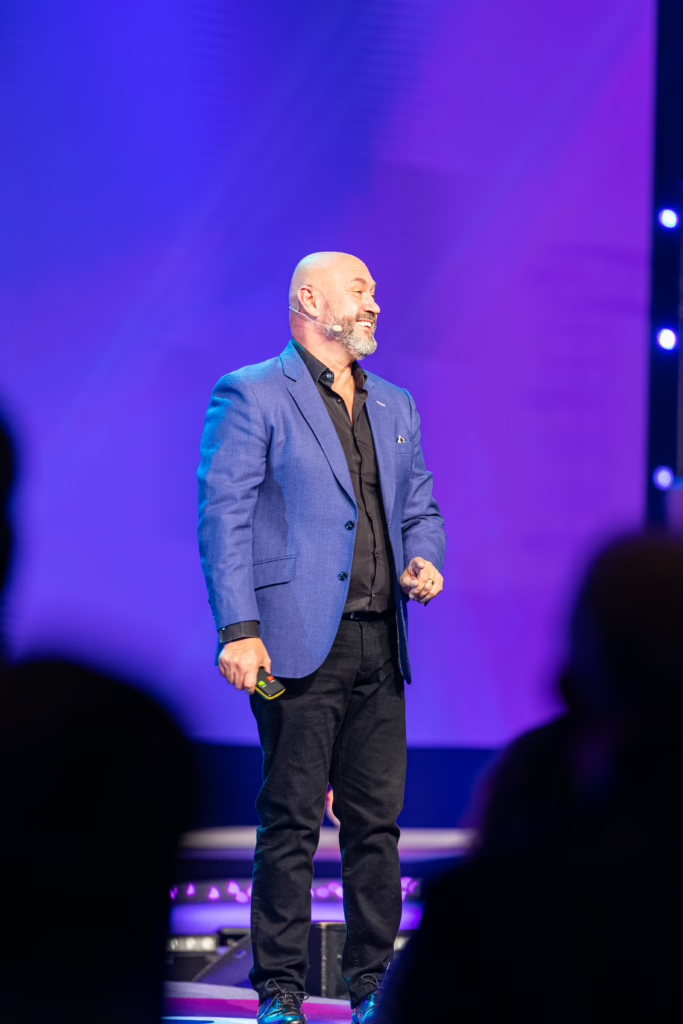
Andrew Bryant is the founder of Self Leadership International, a Certified Speaking Professional, executive coach, and author whose work focuses on self-leadership, leadership development, and human potential. For more than 25 years, he has spoken and worked with leaders across more than 40 countries, helping audiences examine the internal capabilities that underpin effective leadership: self-awareness, self-regulation, continuous learning, judgment, and personal accountability.
His perspective was shaped by an earlier career in physiotherapy and acupuncture, including work with elite athletes. That clinical background taught him to diagnose underlying causes rather than address symptoms alone—a principle he later carried into leadership development. Bryant founded Self Leadership International in 1999 and subsequently brought his frameworks into keynote speaking, workshops, executive coaching, and management education. He served as external faculty in leadership at Singapore Management University and has taught executives and technical leaders about executive presence and influence through MIT Professional Education.
Bryant co-authored Self Leadership: How to Become a More Successful, Efficient, and Effective Leader from the Inside Out, published by McGraw-Hill in 2012. His 2026 Wiley book, POTENTIAL-IZE: How Leaders Unlock Human Potential in the Age of AI, presents the six-part IGNITE framework—Inspire, Guide, Nurture, Integrate, Transform, and Evaluate—for developing human capability alongside artificial intelligence. His wider body of work also includes The New Leadership Playbook and practical applications of self-leadership to hybrid work, uncertainty, organizational transformation, and sustained performance.
For event buyers, Bryant offers a leadership perspective centered not on competing with AI, but on strengthening the capacities people remain responsible for: making sound judgments, building trust, taking ownership, adapting, and enabling others to grow. His work is especially relevant to executive audiences, leadership teams, and HR and learning professionals seeking to connect human development with the realities of technology-enabled work.