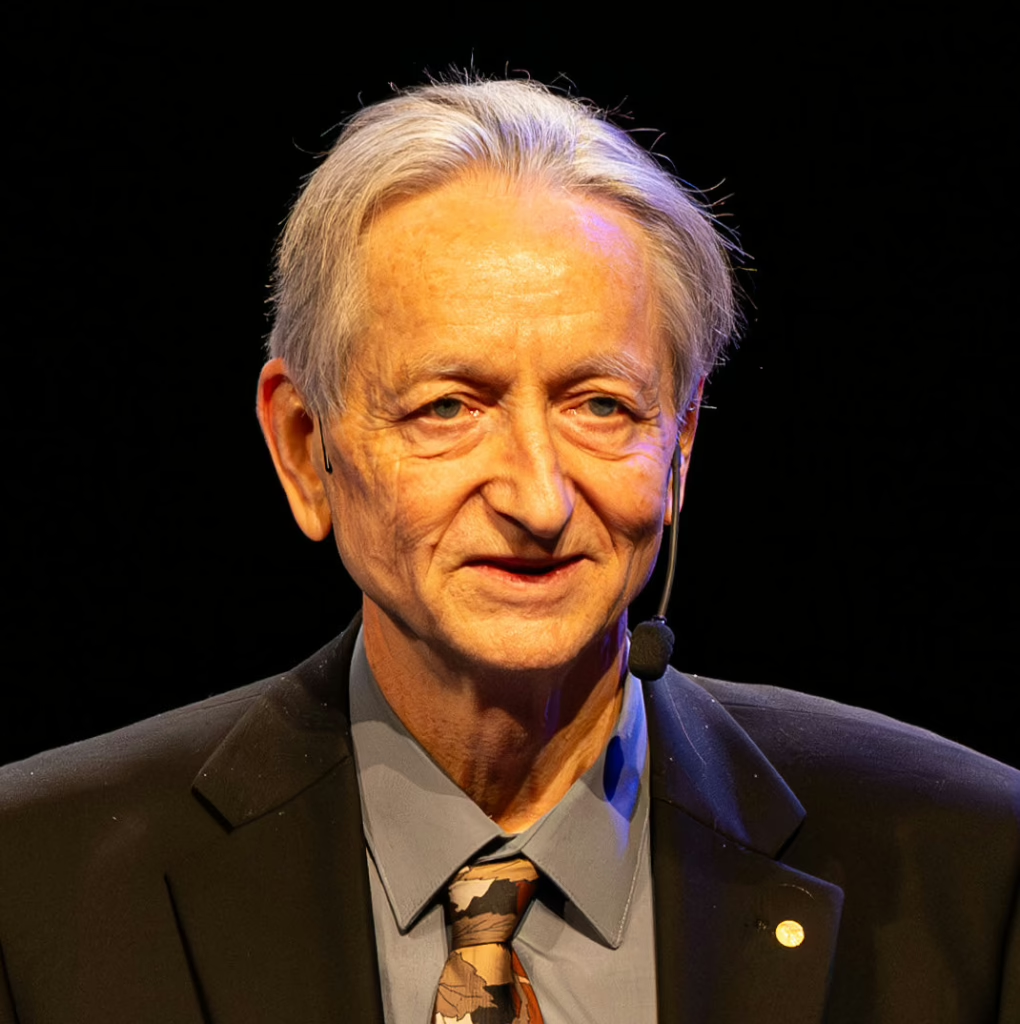
Geoffrey Hinton is the pioneering computer scientist known as the 'Godfather of AI,' whose groundbreaking work on neural networks laid the foundation for today's artificial intelligence revolution. In 2024, Hinton was awarded the Nobel Prize in Physics alongside John Hopfield for foundational discoveries that enable machine learning with artificial neural networks—a recognition that brought his decades of research into the global spotlight. Born in London in 1947 into a family of distinguished intellectuals, Hinton's journey has been one of persistent vision in the face of skepticism. When he began his work on neural networks in the 1970s and 1980s, the field was widely dismissed by the academic establishment. Yet Hinton persevered, driven by a conviction that computers could learn like the human brain.
His breakthrough came with the development of the backpropagation algorithm in 1986, co-authored with David Rumelhart and Ronald Williams, which revolutionized how neural networks learn from data. This work, along with his contributions to Boltzmann machines and deep learning architectures, transformed AI from theoretical curiosity to practical powerhouse. In 2012, Hinton and his students developed AlexNet, a deep convolutional neural network that won the ImageNet competition by a stunning margin and sparked the modern deep learning boom. This achievement led to his joining Google in 2013, where he worked for a decade advancing AI capabilities. Hinton also received the 2018 Turing Award—often called the Nobel Prize of computing—shared with Yoshua Bengio and Yann LeCun, recognizing their collective role in making deep learning a critical component of computing.
What makes Hinton particularly compelling as a speaker is his transformation from AI pioneer to AI safety advocate. In 2023, he made the remarkable decision to leave Google specifically so he could speak freely about the existential risks posed by artificial intelligence. Having spent his career building the technology, he now dedicates himself to ensuring we navigate its dangers responsibly. Hinton speaks with rare authority about both AI's transformative potential—from revolutionizing healthcare to accelerating scientific discovery—and its profound risks, including the possibility that superintelligent systems could eventually surpass human control. He has publicly stated there is a 10-20% chance that AI could lead to human extinction, a sobering assessment from someone who understands the technology better than almost anyone alive.
Hinton's presentations combine technical depth with philosophical reflection, making complex AI concepts accessible to diverse audiences. He doesn't shy away from uncomfortable truths, yet maintains a balanced perspective on both opportunities and threats. Unlike many technologists who either dismiss concerns or succumb to hype, Hinton offers grounded, evidence-based analysis from someone who has shaped the field for over four decades. His academic pedigree is impeccable—holding a PhD from the University of Edinburgh and serving as Professor Emeritus at the University of Toronto—yet his communication style remains clear and engaging.
Today, as societies grapple with AI's rapid advancement, Hinton's voice carries unique weight. He advocates for robust government regulation, increased funding for AI safety research, and international cooperation to manage the technology responsibly. His message resonates across boardrooms, policy circles, and public forums: we have created something extraordinarily powerful, and we must act wisely to ensure it serves rather than threatens humanity. For organizations seeking to understand AI's trajectory and prepare for its impact, few speakers offer Hinton's combination of foundational expertise, intellectual honesty, and moral urgency.