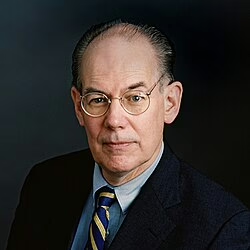
John J. Mearsheimer
R. Wendell Harrison Distinguished Service Professor of Political Science at the University of Chicago and Co-director of the Program on International Security Policy.
John Mearsheimer is the primary architect of "offensive realism," a theoretical framework that views the international system as an anarchic environment where Great Powers are compelled to maximize their relative power. His expertise lies in the structural causes of international conflict, the rise and fall of global orders, and the strategic behavior of states in a multipolar world.
Keynote Topics:
- The Tragedy of Great Power Politics Based on his seminal work, Mearsheimer explains why the quest for regional hegemony is the rational goal of every Great Power. He discusses the inherent instability of the international system and why security competition between major states is an unavoidable feature of global affairs.
The Inevitable Rivalry: The United States vs. China Mearsheimer analyzes the geopolitical friction in the Indo-Pacific, arguing that China’s rise will lead to a Cold War-style confrontation. He explores the strategic imperative for the U.S. to contain China and the risks of a "hot war" emerging from this systemic competition.
The Russia-Ukraine Conflict: A Realist Perspective Drawing from his controversial and widely debated analysis, Mearsheimer discusses the structural causes of the war in Ukraine. He focuses on the implications of NATO expansion, the concept of "buffer states," and the long-term consequences for European security.
The Great Delusion: Why Liberal Hegemony Fails This session critiques the post-Cold War effort by the West to spread liberal democracy and integrate the world into a single rules-based order. Mearsheimer explains why nationalism and realism consistently trump liberal ideals in the arena of foreign policy.
The Return of Multipolarity and the Future of NATO Mearsheimer examines the shift from a unipolar world dominated by the U.S. to a multipolar system featuring Russia and China. He assesses how this transition weakens traditional alliances and requires a return to "offshore balancing" as a primary grand strategy.
speaker Bio:
John J. Mearsheimer is an American political scientist and international relations scholar who has fundamentally reshaped the study of global politics. He is the R. Wendell Harrison Distinguished Service Professor of Political Science at the University of Chicago, where he has taught since 1982. A graduate of the United States Military Academy at West Point, Mearsheimer served five years as an officer in the U.S. Air Force before transitioning to academia. He earned his PhD from Cornell University, where he began developing the rigorous, structural approach to international relations that has made him one of the most cited and influential scholars in the field.
Mearsheimer is best known for his theory of "offensive realism," which he detailed in his 2001 masterpiece, The Tragedy of Great Power Politics. Unlike "defensive realists" who argue that states merely seek to maintain the status quo, Mearsheimer posits that because the international system is anarchic and intentions are always uncertain, rational states must constantly seek to increase their power. He argues that the ultimate goal for any state is to become a regional hegemon—the only power in its part of the world—while ensuring no other state achieves the same status elsewhere. This "tragic" view of world politics suggests that conflict is not a result of "bad" leadership or flawed ideologies, but rather a direct product of the system’s architecture.
Throughout his career, Mearsheimer has been a vocal critic of mainstream American foreign policy. In 2007, he co-authored The Israel Lobby and U.S. Foreign Policy with Stephen M. Walt, a book that sparked intense global debate by examining the influence of domestic interest groups on U.S. strategic decisions. More recently, in The Great Delusion: Liberal Dreams and International Realities (2018), he offered a blistering critique of "liberal hegemony," arguing that the American attempt to remake the world in its own image has led to failed states, perpetual wars, and the erosion of international stability.
Mearsheimer’s analysis of the Russia-Ukraine conflict has gained massive global attention, particularly his assertion that the roots of the crisis lie in Western efforts to integrate Ukraine into the EU and NATO. His perspectives on the "China Threat" are equally influential; he has long maintained that China’s peaceful rise is impossible and that the U.S. and China are destined for an intense security competition. As of 2026, his work remains at the center of the geopolitical conversation, as the world navigates the definitive return of multipolar rivalry.
Beyond his books, Mearsheimer has received numerous accolades, including the James Madison Award from the American Political Science Association, given every three years to a scholar who has made a distinguished contribution to the field. He is a member of the American Academy of Arts and Sciences and continues to influence both the next generation of scholars and high-level policy debates regarding the future of the American "pacifier" in Europe and the strategic pivot to Asia.

Summary: The Pillars of Mearsheimer’s Realism (2025-2026)
Mearsheimer’s current briefings focus on three critical shifts in the global landscape that validate his offensive realist predictions:
The End of the Unipolar Moment: Mearsheimer argues that the era of U.S. dominance (1991–2017) is officially over. The world is now tri-polar (U.S., China, Russia), which he considers inherently more dangerous than bipolarity due to the complexity of shifting alliances and the increased potential for miscalculation.
The "Stopping Power of Water": A core component of his theory, he continues to emphasize that the Atlantic and Pacific Oceans prevent any state from achieving global hegemony. This geography forces the U.S. to act as an "offshore balancer," intervening only when a local power (like China in Asia) threatens to dominate its respective region.
Nationalism vs. Globalism: Mearsheimer asserts that nationalism remains the most powerful political ideology in the world. He predicts that the "clash" between national interests and global institutional mandates will continue to favor the former, leading to the further fragmentation of global trade and international law.
speaker Video:
Explore keynote speakers, topics & insights
Keynote Topics & Curated Speaker Examples→
Insights & Strategic Deep Dives →
Example Speaker Curation:
Geopolitics & Global Risks →