
THE ARGUMENT IN 60 SECONDS
- The shift: Geopolitical fragmentation is intensifying, but globalisation is not simply reversing. Connections are being reorganised around tariffs, export controls, industrial policy and security concerns.
- Why it matters: A company can be commercially diversified yet strategically dependent on one government, technology stack, payment system, supplier or transport corridor.
- The decision: Boards should stop asking whether globalisation is ending and identify which dependencies become liabilities when political priorities override economic efficiency.
The world is fragmenting — but it is not falling apart
One of the most consequential strategic mistakes a board can make in 2026 is to confuse geopolitical fragmentation with the end of globalisation.
The political system is plainly becoming more contested. Industrial policy has returned. Tariffs and export controls are being used for strategic as well as economic purposes. Governments are scrutinising technology, investment, data, energy and critical minerals through a national-security lens.
Yet the economic evidence does not describe a world separating neatly into self-contained blocs.
The World Trade Organization reports that global goods and services trade reached a record US$34.65 trillion in 2025. World merchandise trade grew by 4.6 per cent in volume terms, while 72 per cent of global goods trade continued to take place under the WTO’s core most-favoured-nation terms. At the same time, the WTO describes a deeply integrated, increasingly multipolar economy whose global value chains are under growing geopolitical pressure.
That is the strategic tension.
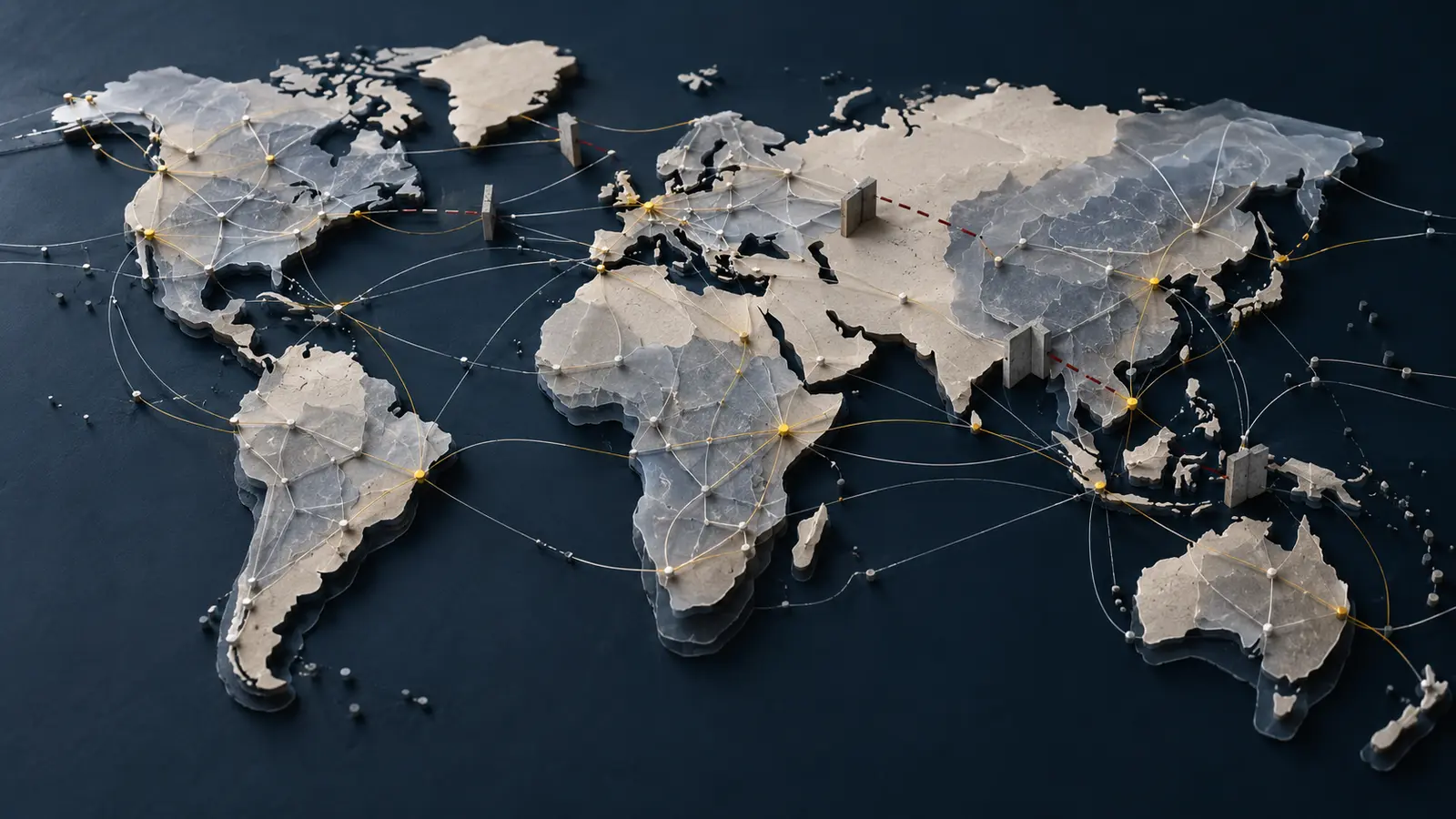
The world is not moving cleanly from globalisation to deglobalisation. It is moving from a system in which efficiency dominated many cross-border decisions to one in which efficiency must increasingly coexist with security, political alignment, technological sovereignty and resilience.
For leaders, the distinction is fundamental. If globalisation were simply reversing, the logical response would be localisation. But if globalisation is being rewired, indiscriminate retreat can create as many vulnerabilities as it removes.
The boardroom question is no longer How global should we be? It is: Which connections create advantage, which create dependence, and which may become politically contestable?
When state power overrides economic logic
Ian Bremmer’s work provides one lens on this shift: volatility increasingly originates inside countries and institutions that companies previously treated as anchors of predictability.
At the start of 2026, Eurasia Group ranked what it called the “US political revolution” as its number-one global risk and the Trump administration’s more assertive Western Hemisphere policy — labelled the “Donroe Doctrine” by the firm — as number three. Those are Eurasia Group’s analytical characterisations, not neutral descriptions of US politics. What matters for business is the underlying proposition: policy uncertainty can increasingly originate inside systemically important economies, not only in markets traditionally classified as politically risky.
Boards therefore need more than a list of risks. They need a theory of what happens when national interests collide.
John Mearsheimer supplies a deliberately hard-edged one. His offensive realism puts the distribution of power at the centre of international politics. In this framework, great powers seek to prevent rivals from dominating strategically important regions, while economic cooperation remains subordinate to security when the two come into conflict. His advocacy with Stephen Walt of “offshore balancing” represents one proposed US grand strategy built around that logic.
Many of Mearsheimer’s interpretations of particular conflicts and Western foreign policy are contested. A corporate leadership team does not have to accept them to make use of the question his framework forces onto the table:
What happens to our strategy if governments stop treating economic efficiency as the highest-order objective?
That question reaches far beyond defence companies. A semiconductor may be a commercial product until export controls make it a strategic asset. A cloud platform may be an efficiency decision until data sovereignty changes the procurement calculus. A port, mine, payment rail or battery material can move from the operations agenda to the national-security agenda remarkably quickly.
Geopolitics enters the enterprise precisely at the moment when something commercially ordinary becomes politically strategic.
Economic interdependence has become an instrument of power
This is where Agathe Demarais adds a particularly useful perspective.
Demarais, now a senior policy fellow at the European Council on Foreign Relations after previously leading global forecasting at the Economist Intelligence Unit, focuses on economic statecraft: sanctions, export controls, trade restrictions, financial infrastructure and the ways states translate economic leverage into political influence.
Her work exposes an important change in how executives should think about dependence.
Traditional risk management tends to ask whether a supplier, market or country could fail. Geoeconomic risk asks a different question: Could the relationship continue functioning technically while becoming politically unacceptable?
A bank can remain solvent while access to a payment system is restricted. A component supplier can keep producing while export licences disappear. A profitable market can remain attractive while sanctions, tariffs or political scrutiny change the economics of serving it.
For companies, this makes conventional diversification insufficient. Buying from five suppliers does not create much resilience if all five depend on the same country for a critical upstream input. Multiple banking relationships may offer little protection if they rely on the same settlement infrastructure. Three cloud providers do not necessarily create strategic redundancy if regulation could expose all three to the same jurisdictional constraint.
The relevant unit of analysis is therefore no longer simply the supplier or market. It is the dependency chain behind it.
Power has a second map: connectivity
A purely realist reading of the world can nevertheless create its own blind spot. Governments matter enormously, but they are not the only actors organising the global economy.
Parag Khanna has spent much of his work arguing that infrastructure and connectivity create a second map of power alongside the political map. His 2016 book Connectography made that argument through transport, energy, urban and communications networks. In a 2026 essay for Foreign Policy, he pushes the idea further: attempts to describe the emerging system simply as post-American, multipolar or divided into blocs understate its heterogeneity.
The data supports part of that intuition. According to the WTO, the share of low- and middle-income economies in global trade rose from 23 per cent in 1995 to 45 per cent in 2024. Economic weight has become substantially more distributed even while major powers compete over the rules.
This creates room for countries and commercial hubs that do not fit comfortably into a binary bloc model. Trade may be redirected through new manufacturing bases. Capital may seek jurisdictions that combine access, infrastructure and political flexibility. Supply chains can reorganise around intermediate economies rather than simply return home.
That does not mean connectivity makes geopolitics irrelevant. It means fragmentation is likely to be porous.
For business, that is a more demanding environment than either an integrated world or a divided one. Companies have to understand both maps simultaneously: who has political authority, and where the actual flows of goods, capital, technology and data can still move.
Governments · sanctions · export controls · security policy · regulation
Suppliers · infrastructure · energy · capital · data · logistics
Alternatives · substitution time · regional capacity · licences · inventory · partnerships
Strategic resilience = understanding where all three maps overlap.
Optionality is more valuable than prediction
Boards cannot forecast every intervention, sanction package, election, conflict or regulatory shift. Nor should they try.
The more useful objective is to reduce the number of geopolitical events capable of leaving the company with no good option.
A resilient company does not necessarily minimise foreign exposure. It understands its critical exposures deeply enough to know where substitution is difficult, where political authority is concentrated and where an alternative route could be created before it is needed.
WHAT THIS CHANGES FOR LEADERS
- Map dependencies beyond tier-one relationships.Identify critical jurisdictions, technologies, currencies, logistics corridors, standards and upstream inputs behind major revenue streams and operating systems.
- Separate concentration from indispensability.A large exposure can be manageable when alternatives exist; a small but irreplaceable component can represent a far greater strategic risk.
- Use scenarios to define triggers, not predict outcomes.Decide in advance what level of sanctions risk, export restriction, regulatory divergence or conflict exposure would trigger investment, exit or diversification.
- Pay for options before they look efficient.Secondary suppliers, additional licences, regional capacity or alternative infrastructure may look costly in normal conditions. Their value appears when the primary route becomes unavailable.
This is a different interpretation of resilience from simply holding more inventory or relocating production closer to headquarters. It is the ability to preserve agency.
The strongest strategic position in a fragmented but interconnected world is rarely total self-sufficiency. It is having enough alternatives that another actor cannot easily determine your choices for you.
Four lenses, four different stage conversations
This distinction also matters when geopolitical strategy becomes the subject of a leadership summit or conference. A generic brief asking for “a geopolitics speaker” hides very different intellectual needs.
Political risk

Ian Bremmer
What is changing now, which assumptions are weakening and where volatility may emerge next. ↗Power competition

John Mearsheimer
Where security interests may outweigh commercial interdependence. ↗Connectivity

Parag Khanna
How flows, infrastructure, regions and new hubs reshape economic geography. ↗The corporate response

Abishur Prakash
How geopolitical fragmentation reshapes technology, supply chains, market access and the strategic choices companies must make next. ↗Those are not interchangeable keynotes. The right choice depends on what the audience actually needs to understand differently when it leaves the room. Explore Scurati’s Geopolitics & Global Risks 3+1 for another practical starting point.
BOOKS SHAPING THE CONVERSATION
The Tragedy of Great Power Politics
John J. Mearsheimer · updated edition, 2014
A foundational statement of offensive realism and a challenge to assumptions that economic interdependence can neutralise strategic rivalry.
Connectography
Parag Khanna · 2016
A counterweight to state-centric geopolitics, showing how infrastructure, cities and cross-border networks create an alternative geography of power.
Backfire
Agathe Demarais · 2022
An examination of sanctions and export controls that makes visible the unintended consequences of turning global networks into instruments of state power.
The Great Fracturing: How Geopolitics Is Breaking the World
Abishur Prakash · 2026
A business-facing account of how geopolitical fracture is rewiring trade, technology, finance, connectivity and the choices organisations face.
SELECTED SOURCES
