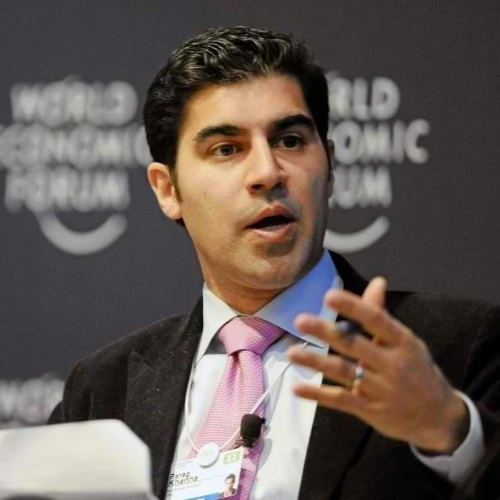
Parag Khanna is a global strategy adviser, author and the founder and CEO of AlphaGeo, an AI-powered geospatial analytics platform focused on resilient investment. His work examines how connectivity, political competition, demographic change and climate pressures reshape the geography of economic activity. He combines research with extensive international fieldwork and experience briefing business and government audiences.
Khanna holds a doctorate in international relations from the London School of Economics and bachelor’s and master’s degrees from Georgetown University’s School of Foreign Service. Born in India and raised in the United Arab Emirates, New York and Germany, he developed an international perspective before beginning a career spanning research institutions, policy and strategic advisory work.
His earlier roles include work at the Council on Foreign Relations, the World Economic Forum and the Brookings Institution. He was a senior research fellow at the New America Foundation and at the National University of Singapore’s Lee Kuan Yew School of Public Policy. He also advised the US National Intelligence Council’s Global Trends programme and served on Singapore’s Committee on the Future Economy.
His books approach global change from complementary directions. The Second World examines competition for influence across emerging regions; Connectography places infrastructure and supply-chain networks at the centre of the analysis. The Future Is Asian explores Asia as a diverse, increasingly interconnected region, while MOVE considers how people’s search for opportunity and security may reshape societies and economies. Together, they extend his argument beyond a conventional country-by-country account.
For executive audiences, Khanna is particularly relevant when a brief involves regional strategy, long-term location decisions or the relationship between geopolitical risk and commercial networks. His perspective invites leaders to examine how capital, talent, goods and information actually move—and where their organisation’s map of the world no longer matches those connections.